 MinuteRead
30 min
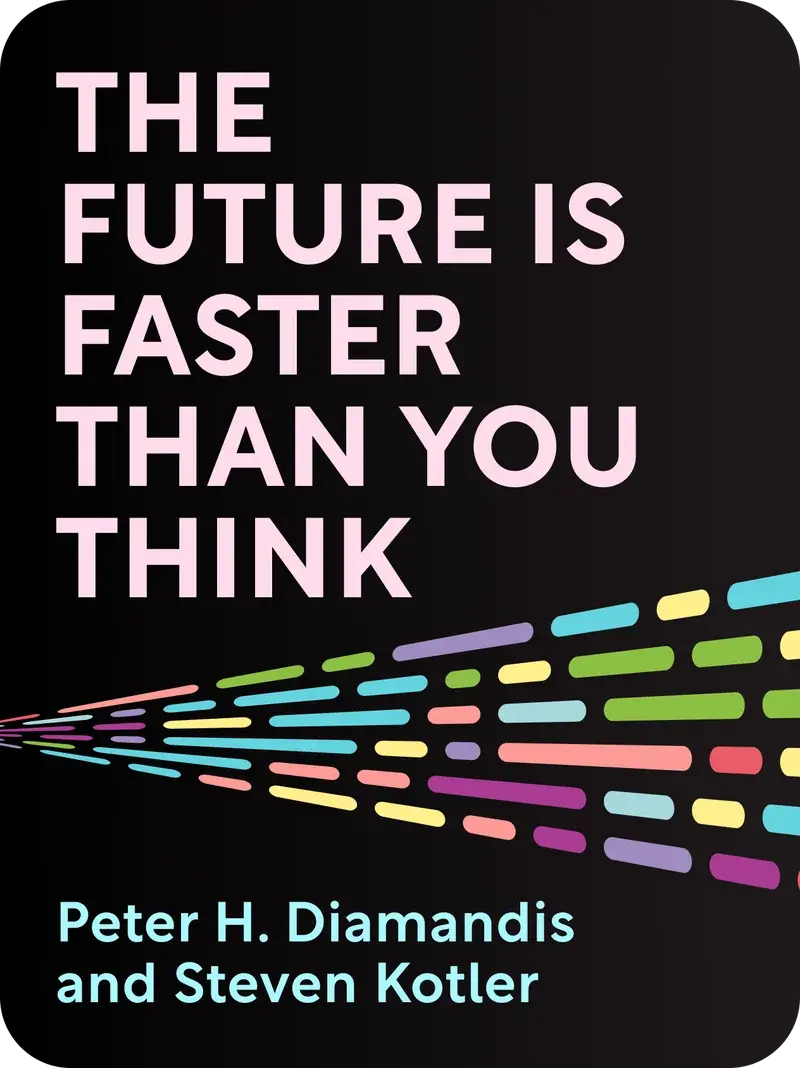
Book summary
Premium summary · Opens in the app · 30 min read
Imagine waking up one morning to discover that everything you knew about how the world works has changed overnight. The job you trained for no longer exists. The products you buy are manufactured in your own home. The doctor who treats you is a machine. The car that takes you to work flies. This is not science fiction. This is the near future.
**Author:** Peter H. Diamandis
**Estimated Reading Time:** 45 minutes
**What You'll Learn:**
- Why the pace of technological change is about to accelerate beyond anything humans have experienced - How converging technologies are reshaping every major industry - What these changes mean for your career, investments, and daily life - How to position yourself to thrive in a world of accelerating disruption
**Who This Book Is For:**
This book is for anyone who senses that the world is changing faster than their ability to keep up. It is for entrepreneurs looking for the next great opportunity, professionals worried about disruption, parents wondering what kind of future their children will inherit, and curious minds who want to understand the forces reshaping civilization. If you have ever felt overwhelmed by headlines about artificial intelligence, gene editing, or flying cars, this book will give you a framework for understanding what is actually happening and why it matters.
Imagine waking up one morning to discover that everything you knew about how the world works has changed overnight. The job you trained for no longer exists. The products you buy are manufactured in your own home. The doctor who treats you is a machine. The car that takes you to work flies. This is not science fiction. This is the near future. Peter Diamandis wrote this book because he believes most people are fundamentally unprepared for what is coming. Not because they lack intelligence or ambition, but because their mental models are calibrated for a world that is about to disappear. We think in straight lines. Technology moves in curves. The problem is not that change is coming. Change has always been with us. The problem is the rate of change. For most of human history, a person could expect to live their entire life in a world that looked much like the one they were born into. Your grandparents' tools were your tools. Your parents' skills were your skills. The future arrived slowly enough that you could ignore it. That era is over. We are now living through a period of technological acceleration unlike anything in recorded history. The combustion engine took decades to transform transportation. The smartphone transformed communication in less than ten years. The next wave of technologies will transform entire industries in months, not years. What makes this moment different is not any single technology. It is convergence. Artificial intelligence is combining with robotics. Robotics is combining with biotechnology. Biotechnology is combining with virtual reality. Virtual reality is combining with blockchain. Each technology amplifies the others, creating possibilities that no single field could achieve alone. Consider what happens when AI meets medicine. Suddenly, a machine can read millions of medical images…
Continue reading in the MinuteRead app
Get the complete 30-minute summary of The Future Is Faster Than You Think
Get the complete summary in the appTechnology grows exponentially, not linearly. The next decade will bring more change than the previous fifty years.
The real power comes from convergence. Multiple technologies combining create capabilities no single technology can achi
AI is a general-purpose technology that will transform every industry it touches.
Robotics extends AI into the physical world, transforming manufacturing, healthcare, and transportation.
VR and AR are platforms for experience that will change how we learn, connect, and work.
3D printing enables customization, on-demand production, and distributed manufacturing.
"The Future Is Faster Than You Think" is a strong fit if you want practical ideas around business, technology, science, especially themes like technology grows exponentially, not linearly. the next decade will bring more change than the previous fifty years; the real power comes from convergence. multiple technologies combining create capabilities no single technology can achi. The MinuteRead summary distills these concepts into a focused read, whether you're deciding whether to buy the book or applying its lessons at work.
Dr. Peter H. Diamandis is a prominent figure in innovation, space exploration, and futurism. He founded the XPRIZE Foundation and co-founded several companies focused on longevity, space resources, and commercial spaceflight. Diamandis is also the Executive Founder of Singularity University and a New York Times bestselling author. He holds degrees from MIT and Harvard Medical School. His work aims to advance technology and solve global challenges. The Greek government honored him with a postage …
View all summaries by Peter H. DiamandisContinue Reading
Access the complete 30-minute summary and thousands more nonfiction books in the MinuteRead app.

Continue reading the complete summary in the MinuteRead app.






