 MinuteRead
30 min
Book summary
Premium summary · Opens in the app · 30 min read
Every nation tells itself stories about what makes its people exceptional. The French point to their sophistication. The British to their stoicism. The Germans to their discipline. Americans have always told a different kind of story, one filled with restless energy, impossible dreams, and the conviction that tomorrow can be radically better than today.
**Author:** John D. Gartner
**Estimated Reading Time:** 48 minutes
**What You'll Learn:**
- Why America produces a disproportionate number of world-changing entrepreneurs, explorers, and visionaries - How hypomanic temperament functions as an evolutionary advantage rather than a pure liability - The psychological profile shared by figures like Christopher Columbus, Alexander Hamilton, and Andrew Carnegie - Why immigration acts as a genetic screening mechanism for ambition and risk tolerance - How to recognize and channel hypomanic traits in yourself and others
**Who This Book Is For:**
Anyone who has ever felt restless, driven, or unable to settle for the status quo. Entrepreneurs who sense they think differently from the people around them. Leaders who want to understand the psychology behind transformative vision. And readers curious about why America, for better and worse, became the world's engine of innovation.
Every nation tells itself stories about what makes its people exceptional. The French point to their sophistication. The British to their stoicism. The Germans to their discipline. Americans have always told a different kind of story, one filled with restless energy, impossible dreams, and the conviction that tomorrow can be radically better than today. But what if that story is not merely mythology? What if there is something measurably different about the American psychological makeup, something rooted not in culture alone but in biology? John D. Gartner, a clinical psychologist specializing in mood disorders, stumbled onto this question from an unexpected direction. While treating patients with bipolar disorder, he noticed something peculiar. Many of his patients, when in their hypomanic states, described feelings that sounded remarkably similar to the way Americans have historically described their national character. Boundless energy. Grandiose optimism. A compulsion to take risks. An unshakeable belief in their own destiny. This observation led him to a provocative hypothesis. What if America's founding stock was disproportionately hypomanic? What if the act of immigration itself selected for a particular kind of temperament, one characterized by restlessness, ambition, and a willingness to abandon everything familiar in pursuit of something better? The implications of this idea are profound. It suggests that America's economic dynamism, its culture of innovation, and even its periodic bouts of irrational exuberance are not accidents of history. They are the predictable consequences of a population enriched, generation after generation, with genes that predispose people toward hypomanic behavior. Gartner is careful to distinguish hypomania from full-blown mania. Hypomania sits on the bipolar spectrum, but it is a milder state. People experiencing hypomania do not lose touch with reality. They remain functional, often highly functional. They sleep less, work more, think faster, and feel an infectious enthusiasm that draws others into their orbit. They are, in many ways, the people we celebrate…
Continue reading in the MinuteRead app
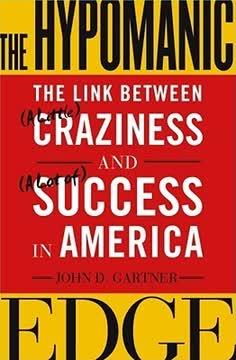
Get the complete 30-minute summary of The Hypomanic Edge
Get the complete summary in the appAmerica's national character is rooted in hypomanic temperament, concentrated in the population through generations of i
Immigration selects for people who are restless, optimistic, and willing to take risks.
Hypomanic traits include high energy, decreased need for sleep, grandiosity, risk tolerance, and restlessness.
These traits provide advantages in entrepreneurship, exploration, and leadership.
The same traits that enable success can also lead to failure, suffering, and ethical lapses.
The hypomanic edge is a double-edged sword, carrying both gifts and burdens.
"The Hypomanic Edge" is a strong fit if you want practical ideas around business, psychology, self help, especially themes like america's national character is rooted in hypomanic temperament, concentrated in the population through generations of i; immigration selects for people who are restless, optimistic, and willing to take risks. The MinuteRead summary distills these concepts into a focused read, whether you're deciding whether to buy the book or applying its lessons at work.
John D. Gartner is a clinical psychologist specializing in bipolar disorder. He authored "The Hypomanic Edge," which explores the link between hypomania and American success. Gartner's work focuses on the positive aspects of hypomanic traits in entrepreneurship and leadership. He conducted extensive research, including interviews with biographers and relatives of historical figures, to support his hypothesis. Gartner's approach combines psychological analysis with historical biography, offering …
View all summaries by John D. GartnerContinue Reading
Access the complete 30-minute summary and thousands more nonfiction books in the MinuteRead app.

Continue reading the complete summary in the MinuteRead app.






