 MinuteRead
30 min
Book summary
by Matthew E. May
Premium summary · Opens in the app · 30 min read
We live in an age of addition. More features. More information. More options. More complexity. The default response to almost any problem is to add something: another meeting, another rule, another layer of process, another feature no one asked for. We have been conditioned to believe that more is better, that complexity signals sophistication, and that the person with the fullest plate must be the most important.
**Author:** Matthew E. May **Estimated Reading Time:** 18 minutes
**What You'll Learn:** - Why removing things creates more value than adding them - How constraints unlock creativity and innovation - Why leaving gaps engages the imagination more powerfully than completeness - How doing nothing can be your most productive activity - Practical ways to apply subtraction across work and life
**Who This Book Is For:** Anyone who feels overwhelmed by complexity, exhausted by information overload, or stuck in patterns of thinking that no longer serve them. This book is for creators, leaders, designers, and anyone who suspects that the path to better results might involve doing less rather than more.
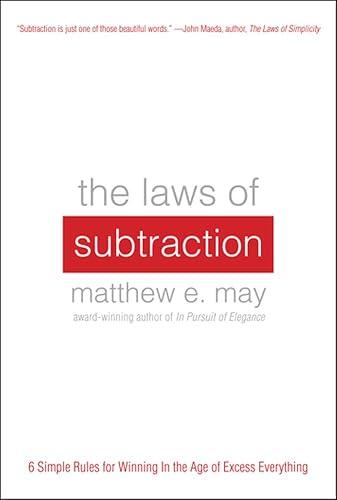
We live in an age of addition. More features. More information. More options. More complexity. The default response to almost any problem is to add something: another meeting, another rule, another layer of process, another feature no one asked for. We have been conditioned to believe that more is better, that complexity signals sophistication, and that the person with the fullest plate must be the most important. But somewhere along the way, we lost something essential. We lost the ability to see that addition has a cost. Every feature added to a product makes it harder to use. Every rule added to an organization makes it slower to respond. Every piece of information added to a presentation makes it harder to remember. Every commitment added to a schedule makes it harder to think. Matthew E. May's book arrives as a quiet rebellion against this culture of excess. His argument is simple but profound: when you remove just the right things in just the right way, something good happens. Not less good. Better. Clearer. More elegant. More effective. The book draws from a remarkable range of sources. May examines how the FedEx logo contains a hidden arrow that emerged from removing parts of letters. He explores why the chaotic traffic circle around the Arc de Triomphe in Paris, with no marked lanes and no traffic lights, actually functions more smoothly than many highly regulated intersections. He investigates why comic book artists deliberately leave gaps between panels, trusting readers to fill in what happens between scenes. He looks at how the Mars Pathfinder team achieved extraordinary results with a fraction of the usual budget and timeline. These examples share a common thread. In each case, someone made a deliberate choice to remove something: a visual element, a rule, a piece of information, a resource. And in each case, the removal created something better than what existed before. The challenge, of course, is that subtraction is harder than addition. Adding is easy. Adding feels productive. Adding gives us something to show for our…
Continue reading in the MinuteRead app
Get the complete 30-minute summary of The Laws of Subtraction
Get the complete summary in the appSubtraction is a creative act. Removing the right things creates value.
What is absent often matters more than what is present. Empty space carries meaning.
Simple rules create effective experiences. Complex rules replace judgment.
Incomplete information engages the imagination. Gaps invite participation.
Constraints fuel creativity. Limitations force new thinking.
Breakthrough requires breaking patterns. Step away to see new possibilities.
"The Laws of Subtraction" is a strong fit if you want practical ideas around business, design, self help, especially themes like subtraction is a creative act. removing the right things creates value; what is absent often matters more than what is present. empty space carries meaning. The MinuteRead summary distills these concepts into a focused read, whether you're deciding whether to buy the book or applying its lessons at work.
Motivated to help readers with when you remove just the right things in just the right way, Matthew E. May wrote “The Laws of Subtraction” to package those ideas for a fast, focused read. In “The Laws of Subtraction”, Matthew E. May focuses on when you remove just the right things in just the right way. Through “The Laws of Subtraction”, Matthew E. May distills the core ideas on business into lessons readers can absorb in a single short sitting. Readers turn to this work when they want Matthew E…
Continue Reading
Access the complete 30-minute summary and thousands more nonfiction books in the MinuteRead app.

Continue reading the complete summary in the MinuteRead app.






