MinuteRead
30 min
Book summary
Premium summary · Opens in the app · 5 min read
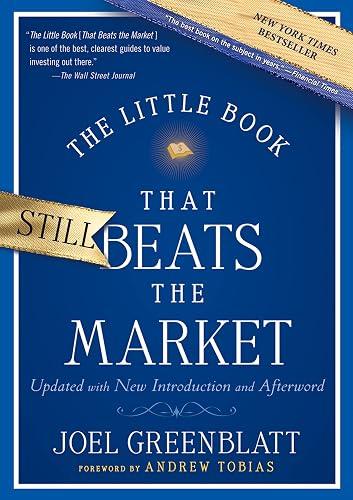
The Little Book That (Still) Beats The Market is a step-by-step tutorial to implement a simple, mathematical formula when buying stocks which guarantees long-term profits.
The Little Book That (Still) Beats The Market is a step-by-step tutorial to implement a simple, mathematical formula when buying stocks which guarantees long-term profits.
Joel’s magic formula is based entirely on two typical numbers used to judge the quality of a stock, combined with a few rules and guidelines.
The first is earnings yield. This number tells you how many dollars you can expect to make, per year, for each dollar you invest in a stock.
You need last year’s earnings per share (how much money the company earned, divided by the total number of shares available), and the current stock price to figure it out. Dividing the two leaves you with a number in the format earnings per dollar, or, simply, your expected return in percent. For example, if last year, the company earned $0.85 per share, and now the stock price is $17, you divide 0.85 by 17, which leaves you with an earnings yield of 0.05. That’s an expected return of 5% for your money, or 5 cents for every dollar you invest.
The second number is return on capital (=ROC). This is calculated by dividing the net, after-tax profit the company made last year, by the book value (the number on their official balance sheet) of invested capital. This tells you how much of your investment the company turns into an actual profit. For example, if a $500,000 investment into a new steel production plant has yielded a $200,000 profit in its first year, that gives you an ROC of 40%, which is really good. Joel says anything above 25% is solid.
Okay, now what do you do with those numbers? You calculate them. For every single company available on a major US stock exchange, like the 3,500 you can find on either the New York Stock Exchange or the Nasdaq. Then, you make two lists. On the first one, you rank all of the companies, starting with the one with the highest earnings yield. The second list you order by highest ROC. Now, you combine both rankings into one. For example, if the company, which ranks first for earnings yield, ranks 153 for ROC, you add both numbers together, giving it a total ranking of 154. In the end, this leaves you with a single, ordered list, telling you which companies perform best for both factors combined. Joel suggests you then invest into the 20-30 top companies on that list, and hold each stock for a year. After a year, sell winners and losers and repeat the process. Note: Of course you don’t have to do all of this by hand. Joel’s come up with a nifty little tool to automatically calculate the list…
Continue reading in the MinuteRead app
Get the complete 5-minute summary of The Little Book That Still Beats The Market
Get the complete summary in the appEvaluate stocks based on earnings yield and return on capital.
Pick winning companies by combining these two factors and ranking them.
Be patient, it’s what makes this formula unpopular, but effective.
"The Little Book That Still Beats The Market" is a strong fit if you want practical ideas around investing, money, personal finance, especially themes like evaluate stocks based on earnings yield and return on capital; pick winning companies by combining these two factors and ranking them. The MinuteRead summary distills these concepts into a focused read, whether you're deciding whether to buy the book or applying its lessons at work.
Motivated to help readers with the Little Book That (Still) Beats The Market is a step-by-step tutorial to implement a simple, Joel Greenblatt wrote “The Little Book That Still Beats The Market” to package those ideas for a fast, focused read. In “The Little Book That Still Beats The Market”, Joel Greenblatt focuses on the Little Book That (Still) Beats The Market is a step-by-step tutorial to implement a simple. Through “The Little Book That Still Beats The Market”, Joel Greenblatt distills the…
View all summaries by Joel GreenblattContinue Reading
Access the complete 5-minute summary and thousands more nonfiction books in the MinuteRead app.

Continue reading the complete summary in the MinuteRead app.