 MinuteRead
30 min
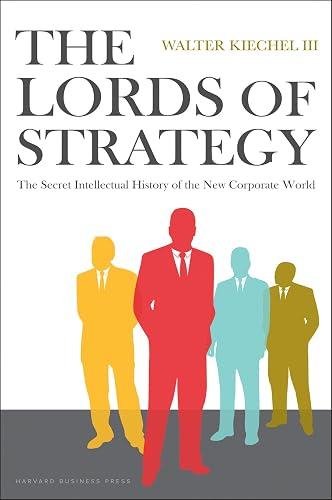
Book summary
by Walter Kiechel III
Premium summary · Opens in the app · 30 min read
For most of the twentieth century, running a business was considered a matter of common sense, experience, and perhaps a bit of luck. Companies planned, certainly. They budgeted, organized, and marketed. But the idea that there existed a distinct intellectual discipline called strategy, with its own frameworks, tools, and experts, was largely absent from corporate life. Business was something you learned by doing, not something you studied as a rigorous field of inquiry.
**Author:** Walter Kiechel III
**Estimated Reading Time:** 3 hours 15 minutes
**What You'll Learn:** How a small group of consultants and academics created the modern field of corporate strategy, transforming how businesses around the world think, compete, and operate. You will understand the intellectual revolution that reshaped capitalism, the key frameworks that emerged from it, and the lasting impact on how companies are managed today.
**Who This Book Is For:** Business leaders, managers, consultants, entrepreneurs, MBA students, and anyone curious about the hidden history of the ideas that govern modern corporate life. If you have ever wondered why companies obsess over competitive advantage, market share, cost curves, and shareholder value, this book reveals where those ideas came from and why they matter.
For most of the twentieth century, running a business was considered a matter of common sense, experience, and perhaps a bit of luck. Companies planned, certainly. They budgeted, organized, and marketed. But the idea that there existed a distinct intellectual discipline called strategy, with its own frameworks, tools, and experts, was largely absent from corporate life. Business was something you learned by doing, not something you studied as a rigorous field of inquiry. Then, in the space of roughly two decades, everything changed. Beginning in the early 1960s, a small group of consultants, academics, and business thinkers began to argue that companies could be understood, analyzed, and managed in a fundamentally more systematic way. They claimed that competition had patterns, that costs behaved predictably, that industries had structures that determined profitability, and that companies could gain durable advantages over rivals by thinking more clearly about their position and capabilities. These ideas, once radical, now form the bedrock of how nearly every significant corporation in the world operates. This book tells the story of that transformation. It is a history of ideas, but also a history of the people who created and spread those ideas. Bruce Henderson, the contrarian founder of the Boston Consulting Group, who insisted that competition was a science waiting to be discovered. Bill Bain, who built a consulting empire on the radical notion that advice should actually produce results. Fred Gluck and Ron Daniel, who dragged the venerable McKinsey & Company into the modern era. Michael Porter, the Harvard professor who gave strategy academic respectability and analytical rigor. Tom Peters, who reminded the strategy world that people and culture mattered as much as numbers and frameworks. The story matters because the ideas these people developed did not stay confined to consulting firms and business schools. They escaped into the wider world and transformed it. The language of strategy now permeates corporate boardrooms, government agencies, nonprofit organizations, and even personal career planning. We speak of competitive…
Continue reading in the MinuteRead app
Get the complete 30-minute summary of The Lords of Strategy
Get the complete summary in the appStrategy is a genuine intellectual revolution that transformed how companies think and compete.
The experience curve shows that costs decline predictably with accumulated experience, making market share a driver of c
The growth-share matrix provides a framework for managing diversified portfolios, classifying businesses as Stars, Cash
Bill Bain changed consulting by focusing relentlessly on client results, not just advice.
Michael Porter brought academic rigor to strategy with frameworks like the Five Forces and the Value Chain.
The human stain reminds us that companies are collections of people, and culture matters as much as analysis.
"The Lords of Strategy" is a strong fit if you want practical ideas around business, history, management, especially themes like strategy is a genuine intellectual revolution that transformed how companies think and compete; the experience curve shows that costs decline predictably with accumulated experience, making market share a driver of c. The MinuteRead summary distills these concepts into a focused read, whether you're deciding whether to buy the book or applying its lessons at work.
Motivated to help readers with but the rise of strategy qualifies as the genuine, Walter Kiechel III wrote “The Lords of Strategy” to package those ideas for a fast, focused read. In “The Lords of Strategy”, Walter Kiechel III focuses on but the rise of strategy qualifies as the genuine. Through “The Lords of Strategy”, Walter Kiechel III distills the core ideas on business into lessons readers can absorb in a single short sitting. Readers turn to this work when they want Walter Kiechel III's pe…
Continue Reading
Access the complete 30-minute summary and thousands more nonfiction books in the MinuteRead app.

Continue reading the complete summary in the MinuteRead app.






