 MinuteRead
30 min
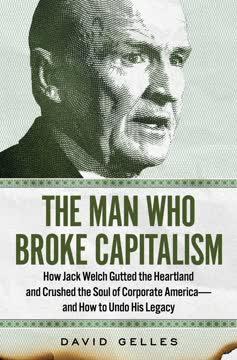
Book summary
by David Gelles
Premium summary · Opens in the app · 30 min read
In the spring of 2021, General Electric announced it would break itself apart. The company that had once been the most valuable corporation on Earth, a symbol of American industrial might and managerial excellence, would cease to exist as a single entity. It would split into three separate companies focused on aviation, healthcare, and energy.
**Author:** David Gelles **Estimated Reading Time:** 45 minutes
**What You'll Learn:**
- How one executive reshaped the American economy and redefined the purpose of a corporation - The specific management practices that created short-term thinking across corporate America - Why the relentless pursuit of shareholder value produced devastating long-term consequences - How Welchism spread beyond GE to infect nearly every major American company - What a post-Welch economy might look like and how some leaders are already building it
**Who This Book Is For:**
This book is for anyone who has wondered why American corporations feel increasingly ruthless, why workers feel disposable, why the gap between executive pay and worker wages has exploded, and why the economy seems optimized for Wall Street rather than Main Street. It is for business leaders questioning the assumptions they inherited, for employees trying to understand the forces shaping their workplaces, and for citizens concerned about the health of American capitalism itself.
In the spring of 2021, General Electric announced it would break itself apart. The company that had once been the most valuable corporation on Earth, a symbol of American industrial might and managerial excellence, would cease to exist as a single entity. It would split into three separate companies focused on aviation, healthcare, and energy. The announcement marked the end of an era. But it also raised a profound question: How did GE, the company that Thomas Edison founded, the company that built jet engines and power turbines and medical imaging machines, the company that Fortune magazine once called the most admired company in America, arrive at this humbling conclusion? The answer, as David Gelles argues in this meticulously reported and deeply unsettling book, can be traced to a single figure: Jack Welch. When Welch took over as CEO of General Electric in 1981, he inherited a company that embodied the postwar American consensus. GE was stable, paternalistic, and focused on engineering excellence. It provided good jobs with good benefits. It invested in research and development. It balanced the interests of employees, customers, communities, and shareholders. It was, in many ways, the model American corporation. Over the next two decades, Welch systematically dismantled that model and replaced it with something entirely different. He made shareholder value the singular purpose of the corporation. He treated employees as costs to be cut rather than assets to be developed. He embraced financial engineering over product innovation. He created a culture of fear and competition that rewarded short-term results at the expense of long-term health. And because GE was so successful, because Welch was so celebrated, his philosophy spread. Executives who trained under Welch took his methods to Boeing, Home Depot, Chrysler, and dozens of other major…
Continue reading in the MinuteRead app
Get the complete 30-minute summary of The Man Who Broke Capitalism
Get the complete summary in the appJack Welch redefined the purpose of the corporation, making shareholder value the singular goal and demoting all other c
The "rank and yank" system created a culture of fear that spread throughout corporate America and destroyed the implicit
GE Capital allowed Welch to smooth out earnings and meet Wall Street expectations, but it created hidden risks that near
Welch's philosophy spread through the GE alumni network, as executives who trained under him took his methods to Boeing,
The relentless focus on short-term results came at the expense of innovation, employee welfare, and long-term sustainabi
The decline of American manufacturing was a choice driven by Welch's philosophy, not an inevitable consequence of global
"The Man Who Broke Capitalism" is a strong fit if you want practical ideas around business, history, economics, especially themes like jack welch redefined the purpose of the corporation, making shareholder value the singular goal and demoting all other c; the "rank and yank" system created a culture of fear that spread throughout corporate america and destroyed the implicit. The MinuteRead summary distills these concepts into a focused read, whether you're deciding whether to buy the book or applying its lessons at work.
David Gelles is a New York Times reporter covering business and finance, with a focus on mergers and acquisitions, corporate governance, and Wall Street. Prior to joining the Times in 2013, he worked for the Financial Times for five years, covering technology and media in San Francisco and New York. Gelles is known for his exclusive jailhouse interview with Bernie Madoff in 2011, which provided new insights into the infamous Ponzi scheme. In addition to his journalism career, Gelles has a backgr…
View all summaries by David GellesContinue Reading
Access the complete 30-minute summary and thousands more nonfiction books in the MinuteRead app.

Continue reading the complete summary in the MinuteRead app.






