 MinuteRead
30 min
Book summary
Premium summary · Opens in the app · 30 min read
W. Edwards Deming wrote this book as a declaration of war against the prevailing style of management. He believed that the way most organizations are run is not merely imperfect. It is actively destructive. The losses it creates are so vast that they cannot be measured, because they touch every corner of an organization and extend far beyond its walls.
**Author:** W. Edwards Deming
**Estimated Reading Time:** 45 minutes
**What You'll Learn:**
- Why most management practices actively destroy quality and productivity - How to see organizations as systems rather than collections of competing parts - The four elements of Deming's System of Profound Knowledge - Why ranking, quotas, and numerical targets create waste - How to build intrinsic motivation and drive out fear - The practical path to transforming your organization and yourself
**Who This Book Is For:**
This book is for leaders, managers, educators, government officials, and anyone who suspects that the prevailing style of management is broken. If you have ever wondered why hard work fails to produce better results, why talented people become disengaged, or why organizations repeatedly sabotage their own success, this book will change how you see everything.
W. Edwards Deming wrote this book as a declaration of war against the prevailing style of management. He believed that the way most organizations are run is not merely imperfect. It is actively destructive. The losses it creates are so vast that they cannot be measured, because they touch every corner of an organization and extend far beyond its walls. Deming's central claim is uncomfortable. He argued that the biggest producer of waste in any organization is not lazy workers, outdated equipment, or foreign competition. It is the management system itself. The practices that managers believe are essential tools of control, such as ranking employees, setting numerical goals, and rewarding individual performance, are precisely the practices that destroy quality, productivity, and morale. This is a difficult message to accept. Most managers have spent their careers learning and applying these practices. They have been rewarded for using them. They have seen colleagues promoted for meeting targets and punishing underperformers. The idea that these actions cause more harm than good feels like an attack on common sense. But Deming was not a motivational speaker offering feel-good advice. He was a statistician, an economist, and a consultant who spent decades studying how organizations actually work. He helped transform Japanese industry after World War II. He taught thousands of leaders in the United States and around the world. His conclusions were based on data, observation, and a deep understanding of how systems behave. The problem, Deming explained, is that most managers do not understand variation. They see a number go up or down and assume someone is responsible. They do not realize that most variation in a system is built into the system itself. When a sales figure drops, a production line slows, or a student's test score falls, the cause is usually not an individual's effort. It is the result of the system in which that individual operates. Punishing…
Continue reading in the MinuteRead app
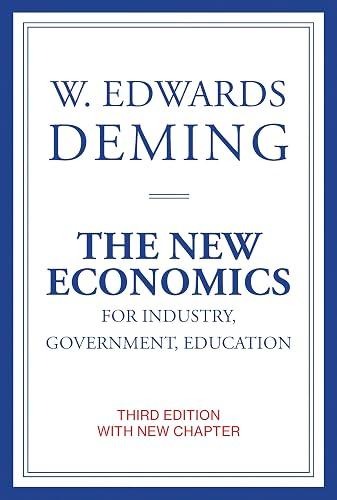
Get the complete 30-minute summary of The New Economics for Industry, Government, Education
Get the complete summary in the appThe prevailing style of management is the biggest producer of waste.
A system must have an aim and be managed as a whole.
Most variation in performance is caused by the system, not by individuals.
Tampering with a stable system increases variation.
Numerical goals and quotas are destructive. Focus on methods, not targets.
Fear destroys intrinsic motivation. Drive out fear.
"The New Economics for Industry, Government, Education" is a strong fit if you want practical ideas around business, management, leadership, especially themes like the prevailing style of management is the biggest producer of waste; a system must have an aim and be managed as a whole. The MinuteRead summary distills these concepts into a focused read, whether you're deciding whether to buy the book or applying its lessons at work.
Motivated to help readers with the present style of management is the biggest producer of waste, W. Edwards Deming wrote “The New Economics for Industry, Government, Education” to package those ideas for a fast, focused read. In “The New Economics for Industry, Government, Education”, W. Edwards Deming focuses on the present style of management is the biggest producer of waste. Through “The New Economics for Industry, Government, Education”, W. Edwards Deming distills the core ideas on business …
View all summaries by W. Edwards DemingContinue Reading
Access the complete 30-minute summary and thousands more nonfiction books in the MinuteRead app.

Continue reading the complete summary in the MinuteRead app.






