MinuteRead
30 min
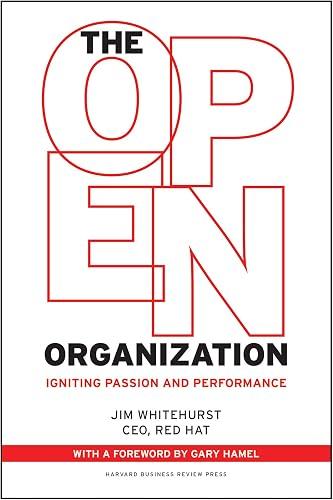
Book summary
by Jim Whitehurst
Premium summary · Opens in the app · 30 min read
Most organizations are built on a fundamental assumption: that a small group of people at the top knows best. This assumption shaped the modern corporation, the modern school system, and the modern government agency. It created structures designed for control, predictability, and efficiency. And for a long time, it worked.
**Author:** Jim Whitehurst
**Estimated Reading Time:** 45 minutes
**What You'll Learn:**
How to build an organization that taps into the passion, creativity, and collective intelligence of its people. You will learn why traditional command-and-control management is failing, how open source principles can transform any organization, and what it takes to lead in a world where engagement and innovation determine success.
**Who This Book Is For:**
Leaders frustrated by slow decision-making and disengaged employees. Managers who sense that hierarchy is stifling innovation. Entrepreneurs building companies from the ground up. Anyone who has ever wondered why the smartest people in the room rarely get to make the decisions.
Most organizations are built on a fundamental assumption: that a small group of people at the top knows best. This assumption shaped the modern corporation, the modern school system, and the modern government agency. It created structures designed for control, predictability, and efficiency. And for a long time, it worked. But something has changed. The world has become too complex, too fast-moving, and too interconnected for any small group of leaders to have all the answers. Markets shift overnight. Technologies disrupt entire industries in months. Customers expect immediate responses. In this environment, the organizations that thrive are not the ones with the smartest executives. They are the ones that can tap into the intelligence, passion, and creativity of everyone they touch. Jim Whitehurst learned this lesson in an unusual way. When he became CEO of Red Hat in 2007, he was a conventional business leader. He had spent years at Delta Air Lines, where he rose to Chief Operating Officer. He had an MBA from Harvard Business School. He understood strategy, operations, and financial management. He knew how to run a company. What he did not understand was open source. Red Hat was not a typical company. It was built on the open source software movement, a global community of developers who collaborated freely, shared their work openly, and made decisions based on merit rather than title. The company's products were created by this community. Its culture was shaped by its values. And its CEO was expected to lead in a way that was fundamentally different from anything Whitehurst had experienced before. At first, he struggled. The company's associates did not simply obey orders. They debated. They challenged. They expected to be included in decisions that affected their work. They cared deeply about the company's mission and were not shy about expressing their opinions. To Whitehurst, this felt chaotic. To the people at Red Hat, it was simply how things worked. Over time, Whitehurst came to understand something profound. The open source way of working was not a quirk of software development. It was…
Continue reading in the MinuteRead app
Get the complete 30-minute summary of The Open Organization
Get the complete summary in the app**Engage participative communities.** Tap into the intelligence and passion of people inside and outside your organizati
**Lead with purpose.** Give people a reason to care that goes beyond profit.
**Build meritocracy.** Let influence be earned through contribution, not conferred by title.
**Include affected people in decisions.** This improves decision quality and eliminates the need for change management.
**Welcome productive debate.** Creative friction sparks innovation and strengthens ideas.
**Be a catalyst, not a commander.** Create conditions for others to do great work.
"The Open Organization" is a strong fit if you want practical ideas around business, management, leadership, especially themes like **engage participative communities.** tap into the intelligence and passion of people inside and outside your organizati; **lead with purpose.** give people a reason to care that goes beyond profit. The MinuteRead summary distills these concepts into a focused read, whether you're deciding whether to buy the book or applying its lessons at work.
Motivated to help readers with "An 'open organization'—which I define as an organization that engages participative communities both inside, Jim Whitehurst wrote “The Open Organization” to package those ideas for a fast, focused read. In “The Open Organization”, Jim Whitehurst focuses on "An 'open organization'—which I define as an organization that engages participative communities both inside. Through “The Open Organization”, Jim Whitehurst distills the core ideas on business into lessons read…
Continue Reading
Access the complete 30-minute summary and thousands more nonfiction books in the MinuteRead app.

Continue reading the complete summary in the MinuteRead app.