 MinuteRead
30 min
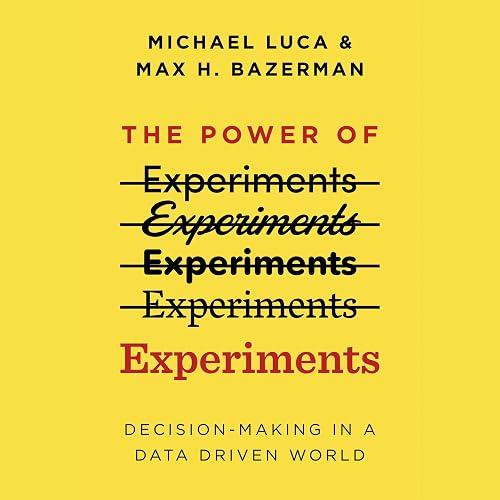
Book summary
by Michael Luca
Premium summary · Opens in the app · 30 min read
Every day, organizations make decisions that shape products, policies, and people's lives. A technology company decides whether to redesign its homepage. A government agency chooses how to word a tax reminder letter. A retailer wonders whether free shipping will increase profits or simply erode margins. A school district debates whether paying teachers bonuses will improve student outcomes.
**Author:** Michael Luca (with Max Bazerman)
**Estimated Reading Time:** 42 minutes
**What You'll Learn:** How organizations use experiments to make better decisions, why intuition often fails, and how you can apply experimental thinking to your own work and life.
**Who This Book Is For:** Leaders, managers, entrepreneurs, policymakers, and anyone who wants to replace guesswork with evidence.
Every day, organizations make decisions that shape products, policies, and people's lives. A technology company decides whether to redesign its homepage. A government agency chooses how to word a tax reminder letter. A retailer wonders whether free shipping will increase profits or simply erode margins. A school district debates whether paying teachers bonuses will improve student outcomes. Most of these decisions are made the same way they have been made for centuries: through intuition, experience, and hierarchy. The most senior person in the room offers an opinion. Others nod. Someone cites a successful competitor. A decision gets made. Sometimes it works. Often it doesn't. And rarely does anyone know why. This is a strange way to run organizations. We would never accept this approach in medicine. Before a drug reaches the market, it undergoes rigorous testing. Researchers randomly assign patients to treatment and control groups. They measure outcomes carefully. They compare results. The drug is approved only if the evidence supports its effectiveness. Yet when it comes to decisions about pricing, hiring, marketing, product design, and public policy, we routinely skip the testing phase entirely. We launch initiatives based on gut feelings. We roll out programs nationwide without piloting them first. We spend millions on advertising without measuring whether it works. Michael Luca and Max Bazerman argue that this is no longer necessary. The tools of experimentation, once confined to academic laboratories and clinical trials, are now available to nearly every organization. Digital platforms make it possible to randomize what customers see. Data systems make it possible to measure outcomes precisely. The cost of running experiments has fallen dramatically. The cost of not running them remains enormous. The book tells the story of how experimentation has moved from the laboratory into the boardroom and the public square. It draws on examples from technology companies like Google, Amazon, and Airbnb, from government agencies like the UK tax authority, and from academic research that has changed how we think about human behavior. The central message is simple but profound: the people making decisions are often wrong about what will work. Not occasionally wrong. Systematically wrong. Even experienced leaders with decades of expertise routinely mispredict how customers will respond to a new feature, how employees will react to a new incentive, or how citizens will respond to a new policy. This is not a criticism. It…
Continue reading in the MinuteRead app
Get the complete 30-minute summary of The Power of Experiments
Get the complete summary in the appIntuition is systematically flawed. Test your assumptions.
Randomization is essential for establishing causality.
Small changes can have large effects. Pay attention to details.
Context matters. What works in one setting may not work in another.
Ethics are not optional. Consider the well-being of participants.
Nudges can improve decisions without restricting freedom.
"The Power of Experiments" is a strong fit if you want practical ideas around business, psychology, economics, especially themes like intuition is systematically flawed. test your assumptions; randomization is essential for establishing causality. The MinuteRead summary distills these concepts into a focused read, whether you're deciding whether to buy the book or applying its lessons at work.
Motivated to help readers with experiments help to complement intuition and guesswork with evidence-based decision making, Michael Luca wrote “The Power of Experiments” to package those ideas for a fast, focused read. In “The Power of Experiments”, Michael Luca focuses on experiments help to complement intuition and guesswork with evidence-based decision making. Through “The Power of Experiments”, Michael Luca distills the core ideas on business into lessons readers can absorb in a single short …
Continue Reading
Access the complete 30-minute summary and thousands more nonfiction books in the MinuteRead app.

Continue reading the complete summary in the MinuteRead app.






