 MinuteRead
30 min
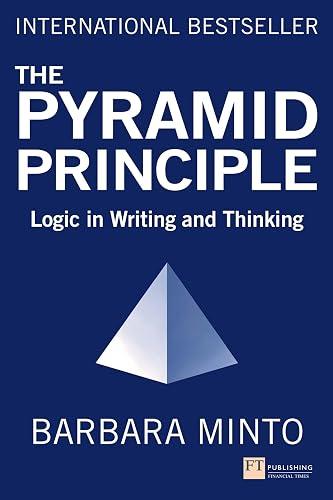
Book summary
Premium summary · Opens in the app · 30 min read
Every day, millions of people sit down to write reports, memos, proposals, and presentations. They gather facts, organize their thoughts, and produce documents they believe are clear and persuasive. Then something strange happens. The reader finishes the document and asks questions the writer thought were already answered. The reader misunderstands the recommendation. The reader gets lost halfway through and never reaches the conclusion.
**Author:** Barbara Minto
**Estimated Reading Time:** 45 minutes
**What You'll Learn:**
- Why the structure of your thinking matters more than the elegance of your sentences - How to organize any document so readers instantly grasp your message - The four logical patterns that govern all clear communication - How to write introductions that capture attention and establish relevance - The difference between deductive and inductive reasoning, and when to use each - How to solve problems systematically before presenting recommendations
**Who This Book Is For:**
Anyone who writes to persuade, inform, or recommend. Consultants, managers, analysts, lawyers, and professionals who need their ideas to be understood and acted upon. If you have ever watched a reader's eyes glaze over while reviewing your work, this book addresses the root cause.
Every day, millions of people sit down to write reports, memos, proposals, and presentations. They gather facts, organize their thoughts, and produce documents they believe are clear and persuasive. Then something strange happens. The reader finishes the document and asks questions the writer thought were already answered. The reader misunderstands the recommendation. The reader gets lost halfway through and never reaches the conclusion. Why does this happen so consistently? Barbara Minto spent years at McKinsey & Company observing this problem. She watched brilliant analysts produce documents that failed to communicate. She saw sound recommendations rejected not because the thinking was flawed, but because the presentation of that thinking was confusing. The problem, she realized, was not a lack of intelligence or effort. It was a lack of structure. Most people write the way they think: they start with data, work through analysis, and eventually arrive at a conclusion. They then present their work in that same sequence, expecting the reader to follow the same intellectual journey. But readers do not want to take that journey. They want to know the destination first, then decide whether the route makes sense. This insight led Minto to develop what she called the Pyramid Principle. The principle is deceptively simple: ideas in any document should be organized as a pyramid, with the main point at the top and supporting arguments arranged logically beneath it. But the implications of this simple idea are profound. The human mind has a natural tendency to impose order on information. When you hear a series of disconnected facts, your brain automatically tries to group them, categorize them, and find relationships between them. This is not a conscious choice. It is how cognition works. The mind seeks patterns and hierarchies because that is the only way it can process and retain information efficiently. Most writing ignores this reality. It presents information in a flat, sequential manner, leaving the reader to…
Continue reading in the MinuteRead app
Get the complete 30-minute summary of The Pyramid Principle
Get the complete summary in the appAlways lead with your main point, conclusion, or recommendation.
Organize every document as a pyramid: main point at the top, supporting arguments beneath.
Respect the mind's limit of about seven items by grouping ideas into categories.
Ensure that summary points actually summarize the ideas below them.
Keep all ideas in a group the same kind of idea.
Order ideas logically: deductively, chronologically, structurally, or comparatively.
"The Pyramid Principle" is a strong fit if you want practical ideas around business, writing, management, especially themes like always lead with your main point, conclusion, or recommendation; organize every document as a pyramid: main point at the top, supporting arguments beneath. The MinuteRead summary distills these concepts into a focused read, whether you're deciding whether to buy the book or applying its lessons at work.
Motivated to help readers with the key skill, Barbara Minto wrote “The Pyramid Principle” to package those ideas for a fast, focused read. In “The Pyramid Principle”, Barbara Minto focuses on the key skill. Through “The Pyramid Principle”, Barbara Minto distills the core ideas on business into lessons readers can absorb in a single short sitting. Readers turn to this work when they want Barbara Minto's perspective on the subject without working through the entire original volume. Barbara Minto i…
View all summaries by Barbara MintoContinue Reading
Access the complete 30-minute summary and thousands more nonfiction books in the MinuteRead app.

Continue reading the complete summary in the MinuteRead app.






