 MinuteRead
30 min
Book summary
by Victor W. Hwang
Premium summary · Opens in the app · 30 min read
Silicon Valley is one of the most studied places on earth. Economists have analyzed its tax policies. Sociologists have mapped its networks. Business schools have dissected its companies. Governments around the world have spent billions trying to replicate it. Yet despite all this attention, most attempts to recreate Silicon Valley have failed.
**Author:** Victor W. Hwang
**Estimated Reading Time:** 45 minutes
**What You'll Learn:**
- Why some places become hotbeds of innovation while others stagnate - The hidden social forces that determine whether ideas flourish or die - How the rules of the rainforest differ fundamentally from the rules of the plantation - The role of keystone individuals in building thriving innovation ecosystems - Practical ways to cultivate collaboration, trust, and serendipity in your own work
**Who This Book Is For:**
Entrepreneurs, investors, policymakers, community leaders, and anyone who has ever wondered why innovation blooms in certain places and not others. If you care about building something new, whether a company, a community, or a career, this book will change how you think about the conditions that make growth possible.
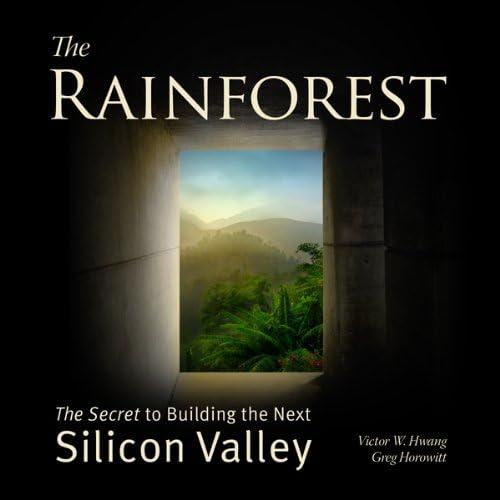
Silicon Valley is one of the most studied places on earth. Economists have analyzed its tax policies. Sociologists have mapped its networks. Business schools have dissected its companies. Governments around the world have spent billions trying to replicate it. Yet despite all this attention, most attempts to recreate Silicon Valley have failed. Why? Victor W. Hwang believes the answer lies in a fundamental misunderstanding of how innovation actually happens. Most people think of economic growth as a mechanical process. You assemble the right ingredients: talented people, good ideas, available capital, supportive policies. You mix them together in the right proportions. You wait. Innovation should follow. But this is not how innovation works. Innovation is not a mechanical process. It is a biological one. The book's title points to the central metaphor. A rainforest is not a carefully managed farm. Nobody plants the trees in a rainforest. Nobody waters the soil. Nobody decides which species will thrive and which will die. Yet rainforests are among the most productive ecosystems on the planet. They generate enormous diversity, constant adaptation, and relentless growth. They do this not through control but through the opposite: through openness, complexity, and the free interaction of countless organisms. A plantation, by contrast, is designed for control. The crops are chosen in advance. The rows are straight. The weeds are pulled. The goal is predictable, efficient output. Plantations work well when you know exactly what you want to grow and how to grow it. But they are terrible at producing novelty. A plantation can never surprise you. The problem, Hwang argues, is that most economic development policy is plantation thinking. Governments and corporations try to engineer innovation by controlling the process. They pick winners. They create rigid plans. They eliminate anything that looks like a weed. In doing so, they destroy the very conditions that make innovation possible. The book's deeper insight is that innovation is fundamentally a social phenomenon. It…
Continue reading in the MinuteRead app
Get the complete 30-minute summary of The Rainforest
Get the complete summary in the appInnovation is a social process, not a technical one. The quality of human relationships matters more than the availabili
Rainforests thrive on emergence. Plantations depend on control. Know which model you are dealing with.
Free markets are not enough. Invisible social barriers prevent valuable collaborations from occurring.
Tribalism is an evolutionary adaptation that now works against us. The greatest value lies in connecting with people who
Keystone individuals are the glue that holds innovation ecosystems together. They bridge social distances and build trus
The seven rules of the rainforest: break rules and dream, open doors and listen, trust and be trusted, experiment and it
"The Rainforest" is a strong fit if you want practical ideas around business, economics, technology, especially themes like innovation is a social process, not a technical one. the quality of human relationships matters more than the availabili; rainforests thrive on emergence. plantations depend on control. know which model you are dealing with. The MinuteRead summary distills these concepts into a focused read, whether you're deciding whether to buy the book or applying its lessons at work.
Motivated to help readers with the essence of life is not so much the atoms and small molecules that go into us as it is the way…those, Victor W. Hwang wrote “The Rainforest” to package those ideas for a fast, focused read. In “The Rainforest”, Victor W. Hwang focuses on the essence of life is not so much the atoms and small molecules that go into us as it is the way…those. Through “The Rainforest”, Victor W. Hwang distills the core ideas on business into lessons readers can absorb in a single s…
Continue Reading
Access the complete 30-minute summary and thousands more nonfiction books in the MinuteRead app.

Continue reading the complete summary in the MinuteRead app.






