MinuteRead
5 min
Book summary
by Sarah Lewis
Premium summary · Opens in the app · 5 min read
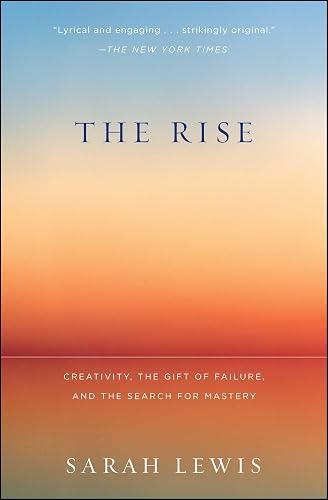
The Rise explains the integral role of failure in all creative endeavors and provides examples of great thinkers who thrived because they viewed failure as a necessary part of their journey towards mastery.
The Rise explains the integral role of failure in all creative endeavors and provides examples of great thinkers who thrived because they viewed failure as a necessary part of their journey towards mastery.
One person whose advice you’ll definitely won’t want to take while failing your way to success is Homer Simpson: “You’ve tried your best and failed miserably. The lesson is: never try.” Endurance, consistency, and persistence are requisites for mastery. At the same time, it’s important that innovators and artists not get tied up in perfectionism while pursuing a goal.
When the author spent a day with the women’s archery team from Columbia University, she learned such focus requires sustained mindfulness and intensity. The Archer’s Paradox refers to the fact that although the archer cannot control the weather, she has to factor in those elements before releasing the arrow. She must be willing to try again and again, whatever the environment dictates.
Mastery comes to those who are willing to shoot countless times while remembering all they can do is observe and give their best.
Author Lewis Hyde said:
The Gap refers to the space between what you’ve achieved and your potential to achieve more. While in the Gap, it makes sense to separate yourself from your critics so that you feel safe taking risks.
The playwright August Wilson wrote on napkins in restaurants. When a waitress asked him why he wrote on those instead of paper, he replied: “Because it doesn’t count.” Writing on something easily discardable gave Wilson the freedom to explore and crumple the napkin without judging himself.
However, isolation must eventually come to an end. Otherwise, you’ll lose touch with reality. Florentine painter Pontormo spent eleven years working on a portrait in the sixteenth century. Neither the painter nor portrait survived such solitary focus.
Criticism and pressure eventually play a crucial role in the growth of a creator and their projects. Leonard Bernstein advised, “To achieve great things, two things are needed: a plan, and not quite enough time.” In the beginning stages, however, too much heat will burn out the artist.
Whatever creative work you do, managing the Gap between your actual work and your vision of what could be is hard enough. So first make sure you are satisfied with your work, and then let the chips fall where they may.
The director of Iowa University’s world-famous writing program has noted that the writers most likely to achieve success are not those with the most natural talent. It is the individual who sits down at the keyboard day in and day out. When one article, short story, or novel is complete, the pro writer begins the next project. They might glance back,…
Continue reading in the MinuteRead app
Get the complete 5-minute summary of The Rise
Get the complete summary in the appInnovative work rarely translates directly to output, so you must relentlessly focus on what you control.
Mental and physical space away from criticism makes room for creatives to take risks.
Using your critics to become better requires grit, but it’s worth it.
"The Rise" is a strong fit if you want practical ideas around creativity, entrepreneurship, motivation & inspiration, especially themes like innovative work rarely translates directly to output, so you must relentlessly focus on what you control; mental and physical space away from criticism makes room for creatives to take risks. The MinuteRead summary distills these concepts into a focused read, whether you're deciding whether to buy the book or applying its lessons at work.
Sarah Elizabeth Lewis is an art and cultural historian and founder of Vision & Justice. Her research focuses on the intersection of visual representation, racial justice, and democracy in the United States from the nineteenth century through the present. She is the John L. Loeb Associate Professor of the Humanities and Associate Professor of African and African American Studies at Harvard University where she serves on the Standing Committee on American Studies and Standing Committee on Women, …
View all summaries by Sarah LewisContinue Reading
Access the complete 5-minute summary and thousands more nonfiction books in the MinuteRead app.

Continue reading the complete summary in the MinuteRead app.