 MinuteRead
30 min
Book summary
by Paul Gibbons
Premium summary · Opens in the app · 30 min read
Every year, organizations around the world spend billions of dollars trying to change. They launch new technology platforms, restructure reporting lines, acquire competitors, enter new markets, and attempt cultural transformations. They hire consultants, develop communication plans, and train managers. They set ambitious goals and celebrate their launch events.
**Author:** Paul Gibbons
**Estimated Reading Time:** 45 minutes
**What You'll Learn:**
- Why roughly half of all organizational change initiatives fail and what actually causes those failures - How cognitive biases and flawed intuitions systematically undermine even well-intentioned leaders - Why traditional "change management" is insufficient and what "change leadership" requires - The scientific principles that separate successful transformations from costly disasters - Practical frameworks for making better decisions under uncertainty - How to build organizations that grow stronger through disruption rather than crumbling under it
**Who This Book Is For:**
This book is for leaders, managers, and change practitioners who are tired of fads and folklore. It is for anyone who has watched a promising initiative collapse despite careful planning, anyone who has wondered why smart people make predictably poor decisions, and anyone who wants to replace guesswork with evidence. If you lead people through change, or if you simply want to understand why organizations so often fail to adapt, this book will change how you think.
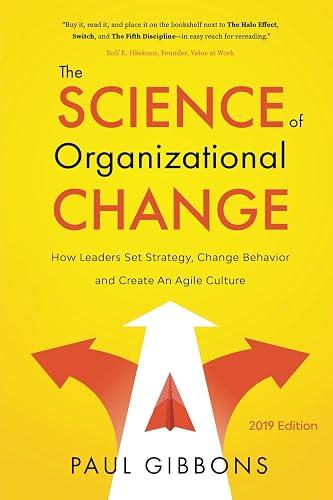
Every year, organizations around the world spend billions of dollars trying to change. They launch new technology platforms, restructure reporting lines, acquire competitors, enter new markets, and attempt cultural transformations. They hire consultants, develop communication plans, and train managers. They set ambitious goals and celebrate their launch events. And then, with alarming regularity, they fail. Not occasionally. Not in exceptional circumstances. Roughly half the time. The numbers are sobering. About half of all mergers fail to deliver the value that justified them. Large IT projects run 45 percent over budget while delivering 56 percent less value than promised. According to IBM's research, only 41 percent of change projects meet their objectives. These are not marginal shortfalls. These are catastrophic wastes of capital, time, and human energy. Yet the most remarkable fact is not that change fails. It is that we continue to approach change the same way, expecting different results. Paul Gibbons wrote *The Science of Organizational Change* to address a fundamental gap in how organizations think about transformation. The business world has spent decades developing sophisticated tools for strategy, finance, and operations. But when it comes to the human dimension of change, most organizations still rely on intuition, anecdote, and folklore. They treat people as a soft issue, something to be managed by communications teams or addressed through motivational speeches. This approach has failed. It has failed because human beings are not simple machines that respond predictably to incentives and information. We are complex, biased, emotional, and deeply social creatures. Our minds evolved for a world of small tribes and immediate threats, not for navigating global organizations in a volatile economy. When we try to lead change without understanding how humans…
Continue reading in the MinuteRead app
Get the complete 30-minute summary of The Science of Organizational Change
Get the complete summary in the app**Half of all change initiatives fail.** This failure is preventable, and the cost runs into billions of dollars annuall
**The root cause of change failure is human, not technical.** People problems are leadership problems.
**Change-agility is the ultimate competitive advantage.** Organizations that adapt quickly thrive; those that cannot are
**Strategic coherence matters more than strategic precision.** Contradictory initiatives waste resources and create cyni
**Your intuitions about risk are systematically flawed.** Use structured tools like pre-mortems and SOCKS analysis to co
**Cognitive biases affect every stage of decision-making.** Design processes that counteract them rather than relying on
"The Science of Organizational Change" is a strong fit if you want practical ideas around business, leadership, psychology, especially themes like **half of all change initiatives fail.** this failure is preventable, and the cost runs into billions of dollars annuall; **the root cause of change failure is human, not technical.** people problems are leadership problems. The MinuteRead summary distills these concepts into a focused read, whether you're deciding whether to buy the book or applying its lessons at work.
Motivated to help readers with dozens of surveys place the actual failure rate at around 50 percent, Paul Gibbons wrote “The Science of Organizational Change” to package those ideas for a fast, focused read. In “The Science of Organizational Change”, Paul Gibbons focuses on dozens of surveys place the actual failure rate at around 50 percent. Through “The Science of Organizational Change”, Paul Gibbons distills the core ideas on business into lessons readers can absorb in a single short sitting.…
Continue Reading
Access the complete 30-minute summary and thousands more nonfiction books in the MinuteRead app.

Continue reading the complete summary in the MinuteRead app.






