 MinuteRead
30 min
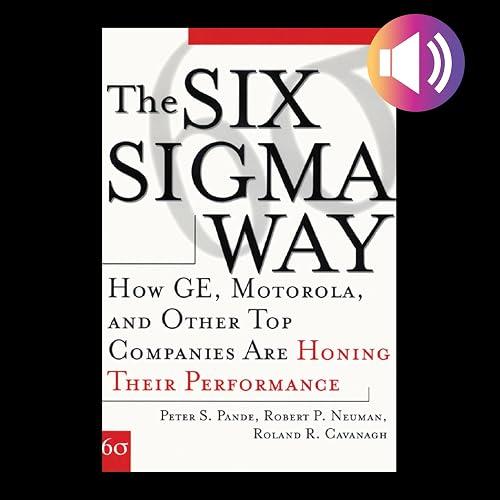
Book summary
by Peter S. Pande
Premium summary · Opens in the app · 30 min read
Every organization struggles with the same fundamental challenge. Despite good intentions, smart people, and hard work, results remain inconsistent. Products ship with defects. Services frustrate customers. Processes break down in predictable but unaddressed ways. Leaders launch improvement initiatives that generate enthusiasm for a few months, then fade into memory as the next priority takes over.
**Author:** Peter S. Pande
**Estimated Reading Time:** 45 minutes
**What You'll Learn:**
- Why Six Sigma became one of the most influential business improvement systems ever created - How to understand and reduce process variation using data - The complete DMAIC framework for solving problems systematically - How to build an organization that continuously improves - Practical ways to apply Six Sigma thinking to your work and life
**Who This Book Is For:**
This book is for anyone who wants to understand how great organizations achieve consistent, measurable results. Whether you are an executive considering a company-wide improvement initiative, a manager looking for better ways to solve problems, or an individual contributor who wants to make a bigger impact, The Six Sigma Way provides a clear, practical roadmap. No advanced statistics background is required. What matters is a willingness to think differently about problems, processes, and performance.
Every organization struggles with the same fundamental challenge. Despite good intentions, smart people, and hard work, results remain inconsistent. Products ship with defects. Services frustrate customers. Processes break down in predictable but unaddressed ways. Leaders launch improvement initiatives that generate enthusiasm for a few months, then fade into memory as the next priority takes over. Why does this happen? Why do capable organizations so often fail to achieve the level of performance they know is possible? The answer, according to Peter Pande, lies not in effort but in approach. Most organizations rely on intuition, experience, and firefighting. When a problem appears, people scramble to fix it. When the immediate crisis passes, attention moves elsewhere. The underlying causes remain untouched, waiting to resurface. This reactive pattern feels productive but rarely produces lasting improvement. Six Sigma offers a fundamentally different approach. It is not a slogan, a quick fix, or a management fad. It is a comprehensive system for understanding how work actually happens, measuring performance honestly, identifying root causes with data rather than opinion, implementing solutions that address those causes, and building controls that keep improvements in place. The name itself comes from statistics. Sigma is the Greek letter used to represent standard deviation, a measure of variation. A process operating at Six Sigma quality produces only 3.4 defects per million opportunities. That is near perfection. But the power of Six Sigma extends far beyond the statistical definition. It is a way of thinking, a set of tools, a leadership philosophy, and a cultural framework that has transformed organizations ranging from manufacturing plants to hospitals to financial services firms. The results speak for themselves. Motorola, where Six Sigma originated in the 1980s, saved an estimated $14 billion over a decade. General Electric, under Jack Welch's aggressive promotion, generated $2 billion in savings within two…
Continue reading in the MinuteRead app
Get the complete 30-minute summary of The Six Sigma Way
Get the complete summary in the app**Variation is the enemy.** Reducing variation is the core of Six Sigma and the path to better quality.
**Customers define quality.** Improvement must be driven by customer requirements, not internal assumptions.
**Six sigma means 3.4 defects per million opportunities.** This is the standard of near perfection.
**DMAIC is the roadmap.** Define, Measure, Analyze, Improve, Control. Follow the sequence.
**Root causes are different from symptoms.** Dig beneath the surface to find what is really going on.
**Averages hide variation.** Measure the full distribution, not just the mean.
"The Six Sigma Way" is a strong fit if you want practical ideas around business, management, leadership, especially themes like **variation is the enemy.** reducing variation is the core of six sigma and the path to better quality; **customers define quality.** improvement must be driven by customer requirements, not internal assumptions. The MinuteRead summary distills these concepts into a focused read, whether you're deciding whether to buy the book or applying its lessons at work.
Motivated to help readers with six Sigma is a comprehensive and flexible system for achieving, Peter S. Pande wrote “The Six Sigma Way” to package those ideas for a fast, focused read. In “The Six Sigma Way”, Peter S. Pande focuses on six Sigma is a comprehensive and flexible system for achieving. Through “The Six Sigma Way”, Peter S. Pande distills the core ideas on business into lessons readers can absorb in a single short sitting. Readers turn to this work when they want Peter S. Pande's pers…
Continue Reading
Access the complete 30-minute summary and thousands more nonfiction books in the MinuteRead app.

Continue reading the complete summary in the MinuteRead app.






