MinuteRead
30 min
Book summary
by Will Durant
Premium summary · Opens in the app · 5 min read
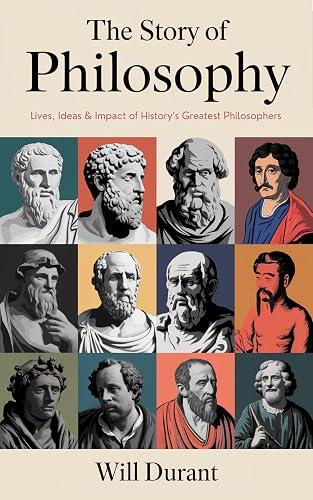
The Story of Philosophy profiles the lives of great Western philosophers, such as Plato, Socrates, and Nietzsche, exploring their views on politics, religion, morality, the meaning of life, and plenty of other important concepts.
The Story of Philosophy profiles the lives of great Western philosophers, such as Plato, Socrates, and Nietzsche, exploring their views on politics, religion, morality, the meaning of life, and plenty of other important concepts.
Ancient Greece is widely known as the pylon of philosophical thinking and science, as the founders of such areas of expertise conducted groundbreaking discoveries in the aged poleis. At first, there was Socrates, considered the founder of Western philosophy.
Socrates first paved the way for questions related to the meaning of humankind and questioned morality, ethics, and governance rules. He believed that wise men should rule the state, such as aristocrats. In fact, his daring observations of the democratic governmental bodies won him a place in history. But they also brought him death, as he was considered culpable for the aristocrat’s coup.
After he was condemned to drink poisonous hemlock, his brilliant student Plato set up an academy of science and popularized Socrates’ principles. He also came up with the famous writing “The Republic”, which frames that opposed to a completely democratic state, people with expertise should rule a nation, in a democratic way.
People should choose their leader according to their academic performance, instead of kinship. Aristotle followed Plato and set up a Lyceum, where students would study biology and natural sciences. He discovered that reptiles and birds have similar structures and so do men and mammals. He also set the foundation for the science of logic and syllogism as a rational argument.
Spinoza was a Jewish immigrant who led his life in Holland after the Portuguese Inquisition in the sixteenth century. He was excellent in his thinking, and grew up to be a star student in the Synagogue. He had a passion for the Jewish culture, Descartes’ philosophy, as well as religion in general.
At first sight, his findings may reveal that he’s an atheist. However, Spinoza was always advocating for the existence of God, yet argued that we shouldn’t interpret the Bible literally. One should read through the metaphors and pick the lessons out of the stories.
He argued that God isn’t a super-being but rather a force of the universe, one with nature. Lastly, Spinoza claimed that there’s no such thing as free will. Humans are led by instincts of survival, and since the body and the mind are one, we are ultimately seeking to fulfill our desires, which we have no control over.
Voltaire was widely known for his controversial writings, as he was always criticizing the French tyranny and way of governance. For this reason, he was imprisoned twice, before he escaped to England. In the British territory, he found enlightenment. He saw how the British rule freely, ports write…
Continue reading in the MinuteRead app
Get the complete 5-minute summary of The Story of Philosophy
Get the complete summary in the appMany of humanity’s essential discoveries start in ancient Greece.
Spinoza reformulated the meaning of religion in the ancient times.
Voltaire helped France enter an enlightenment phase.
"The Story of Philosophy" is a strong fit if you want practical ideas around biography, culture, history, especially themes like many of humanity’s essential discoveries start in ancient greece; spinoza reformulated the meaning of religion in the ancient times. The MinuteRead summary distills these concepts into a focused read, whether you're deciding whether to buy the book or applying its lessons at work.
William James Durant was born in North Adams, Massachusetts, in 1885. He was educated in the Roman Catholic parochial schools there and in Kearny, New Jersey, and thereafter in St. Peter’s (Jesuit) College, Jersey City, New Jersey where he graduated in 1907, and Columbia University, New York. For a summer in 1907 he served as a cub reporter on the New York Journal, but finding the work too strenuous for his temperament, he settled down at Seton Hall College, South Orange, New Jersey, to teach La…
View all summaries by Will DurantContinue Reading
Access the complete 5-minute summary and thousands more nonfiction books in the MinuteRead app.

Continue reading the complete summary in the MinuteRead app.