 MinuteRead
30 min
Book summary
by John A. List
Premium summary · Opens in the app · 30 min read
Every year, billions of dollars are poured into ideas that will never scale. Governments launch pilot programs that show remarkable results, then watch those results evaporate when the program expands. Startups achieve explosive early growth, then collapse under the weight of their own expansion. Nonprofits demonstrate meaningful impact in one community, then fail to replicate that impact elsewhere.
**Author:** John A. List
**Estimated Reading Time:** 45 minutes
**What You'll Learn:** Why some great ideas scale successfully while others collapse, and how to identify the difference before you invest heavily. You will learn the five vital signs that predict whether an idea can scale, the hidden traps that destroy scaling efforts, and practical strategies for building organizations that grow without losing what made them special.
**Who This Book Is For:** Entrepreneurs, policymakers, nonprofit leaders, executives, and anyone who has ever watched a promising idea fail when it grew beyond its original context. If you have ever wondered why a pilot program worked brilliantly but the national rollout flopped, this book is for you.
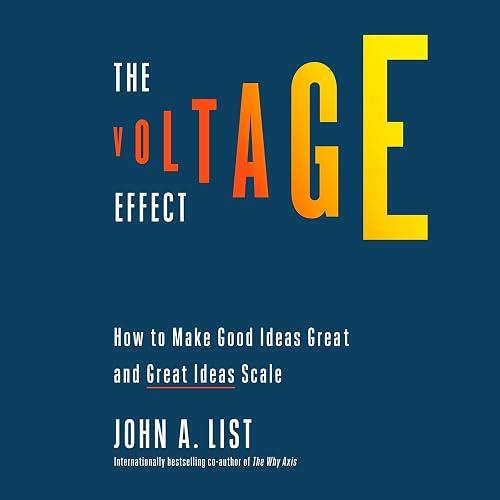
Every year, billions of dollars are poured into ideas that will never scale. Governments launch pilot programs that show remarkable results, then watch those results evaporate when the program expands. Startups achieve explosive early growth, then collapse under the weight of their own expansion. Nonprofits demonstrate meaningful impact in one community, then fail to replicate that impact elsewhere. The pattern is so common that many people have accepted it as inevitable. Scaling, they assume, is simply hard. Some ideas work at small scale and fail at large scale, and there is no reliable way to predict which will succeed. John A. List spent his career proving that assumption wrong. As an economist at the University of Chicago, List pioneered the use of field experiments to understand how economic principles operate in the real world. He did not study scaling from an ivory tower. He worked with companies like Uber and Lyft, with governments, with school systems, and with nonprofits. He watched ideas succeed and fail at scale, and he began to notice patterns. The central insight of his work is both simple and profound: scaling is not a mystery. It is a science. There are identifiable reasons why some ideas scale and others do not. More importantly, there are ways to predict, before you invest heavily, whether an idea has what List calls "voltage." The term comes from an analogy. An idea that works at small scale has a certain voltage, a certain power to produce results. When you scale that idea, you are essentially asking whether that voltage can be maintained across a larger system. Some ideas have high voltage: they produce results that persist and even grow as the idea expands. Other ideas have low or negative voltage: the results diminish or reverse entirely when the idea reaches more people or different contexts. The Voltage Effect is List's attempt to give readers the tools to distinguish between these two types of ideas. It is not a book of abstract theory. It is a practical…
Continue reading in the MinuteRead app
Get the complete 30-minute summary of The Voltage Effect
Get the complete summary in the appVerify that your results are real before you scale. False positives are everywhere.
Test whether your success will transfer to a broader audience. Early adopters are different.
Identify and protect your non-negotiables. They are the active ingredients of your success.
Analyze marginal costs before you grow. Scaling can destroy economics.
Design incentives that work at scale. Incentives shape behavior in predictable ways.
Use marginal thinking to allocate resources. Average returns are misleading.
"The Voltage Effect" is a strong fit if you want practical ideas around business, economics, psychology, especially themes like verify that your results are real before you scale. false positives are everywhere; test whether your success will transfer to a broader audience. early adopters are different. The MinuteRead summary distills these concepts into a focused read, whether you're deciding whether to buy the book or applying its lessons at work.
Motivated to help readers with scaling can succeed only when the non-negotiables remain in place, John A. List wrote “The Voltage Effect” to package those ideas for a fast, focused read. In “The Voltage Effect”, John A. List focuses on scaling can succeed only when the non-negotiables remain in place. Through “The Voltage Effect”, John A. List distills the core ideas on business into lessons readers can absorb in a single short sitting. Readers turn to this work when they want John A. List's per…
Continue Reading
Access the complete 30-minute summary and thousands more nonfiction books in the MinuteRead app.

Continue reading the complete summary in the MinuteRead app.






