 MinuteRead
30 min
Book summary
Premium summary · Opens in the app · 30 min read
The modern workplace was built on a simple assumption: the more hours you put in, the more value you produce. This assumption shaped everything from the forty-hour workweek to the open office to the expectation that employees remain reachable at all hours. It created a culture where exhaustion became a badge of honor and busyness masqueraded as productivity.
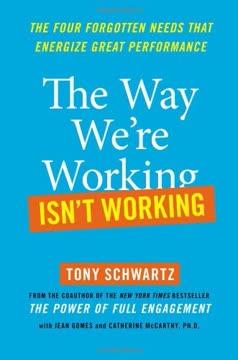
**Author:** Tony Schwartz **Estimated Reading Time:** 45 minutes
Why working longer hours produces diminishing returns. How to manage the four forms of energy that drive sustainable performance. Why renewal is as important as effort. How to build rituals that make high performance automatic. Why purpose matters more than productivity hacks.
Anyone who feels exhausted at the end of the workday yet uncertain what they actually accomplished. Leaders who sense their organizations are running on fumes. Knowledge workers drowning in email and distractions. Anyone who suspects that the current way of working is unsustainable and wants a better path.
The modern workplace was built on a simple assumption: the more hours you put in, the more value you produce. This assumption shaped everything from the forty-hour workweek to the open office to the expectation that employees remain reachable at all hours. It created a culture where exhaustion became a badge of honor and busyness masqueraded as productivity. But something has gone wrong. The average knowledge worker now checks email every six minutes. People report feeling distracted, depleted, and disengaged. Gallup surveys consistently show that roughly two-thirds of employees are not fully engaged in their work. Burnout has become epidemic. The World Health Organization now recognizes burnout as an occupational phenomenon. People are working harder than ever while feeling less effective. Tony Schwartz spent years studying this problem. His journey began with a personal crisis. As a young journalist, he found himself successful on the outside but hollow on the inside. He was producing work that impressed others while feeling increasingly disconnected from himself. The turning point came when he realized that his approach to work was fundamentally unsustainable. He was drawing down his energy reserves without ever replenishing them. This insight led him to study how elite performers in sports, music, and other demanding fields sustain excellence over time. What he discovered was counterintuitive. The best performers were not the ones who pushed themselves relentlessly. They were the ones who alternated periods of intense focus with deliberate periods of recovery. They treated energy as a renewable resource that required active management. The book that emerged from this research challenges the core assumptions of modern work culture. It argues that time is not the fundamental currency of high performance. Energy is. The number of hours you work matters less than the quality of energy you bring to those hours. A fully engaged hour produces more value than three hours of distracted effort. This distinction matters because time is finite while energy can be expanded. You cannot create more hours in a day, but you can dramatically increase the amount of energy you bring to each hour. This shift in perspective opens up…
Continue reading in the MinuteRead app
Get the complete 30-minute summary of The Way We're Working Isn't Working
Get the complete summary in the appManage energy, not time. The quality of your energy determines the quality of your performance.
Sleep seven to nine hours per night. Nothing else compensates for chronic sleep deprivation.
Work in focused sprints of sixty to ninety minutes, followed by genuine breaks.
Single-task. The brain cannot multitask, and task-switching has measurable cognitive costs.
Build rituals. Willpower is unreliable. Automatic routines create lasting change.
Cultivate positive emotions. They expand your capacity and improve your performance.
"The Way We're Working Isn't Working" is a strong fit if you want practical ideas around business, productivity, leadership, especially themes like manage energy, not time. the quality of your energy determines the quality of your performance; sleep seven to nine hours per night. nothing else compensates for chronic sleep deprivation. The MinuteRead summary distills these concepts into a focused read, whether you're deciding whether to buy the book or applying its lessons at work.
Tony Schwartz is a renowned journalist, author, and business consultant. He gained widespread recognition as the ghostwriter and credited co-author of Trump: The Art of the Deal. Schwartz has written extensively on productivity, leadership, and workplace culture. He founded The Energy Project, a consulting firm dedicated to improving organizational performance through employee well-being. His work focuses on helping individuals and companies achieve sustainable high performance by addressing phy…
View all summaries by Tony SchwartzContinue Reading
Access the complete 30-minute summary and thousands more nonfiction books in the MinuteRead app.

Continue reading the complete summary in the MinuteRead app.






