 MinuteRead
30 min
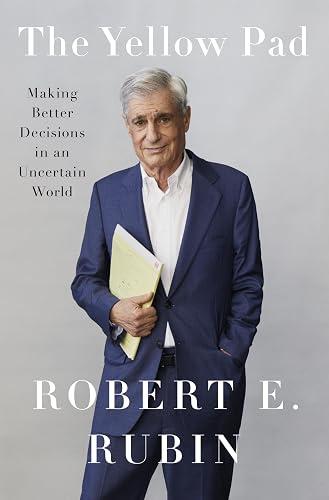
Book summary
by Robert E. Rubin
Premium summary · Opens in the app · 30 min read
Robert Rubin has spent his life making decisions that carried enormous consequences. As a partner at Goldman Sachs, he navigated financial markets where billions of dollars hung in the balance. As Secretary of the Treasury under President Clinton, he confronted economic crises that affected millions of people. At Citigroup, he witnessed firsthand how institutional failures can cascade through the global economy.
**Author:** Robert E. Rubin
**Estimated Reading Time:** 45 minutes
**What You'll Learn:** How to think probabilistically, make sound decisions under pressure, manage risk as a range rather than a single number, lead with intellectual honesty, and navigate complexity without retreating into ideology.
**Who This Book Is For:** Decision-makers in business, government, and everyday life who want a disciplined framework for thinking clearly when the stakes are high and certainty is impossible.
Robert Rubin has spent his life making decisions that carried enormous consequences. As a partner at Goldman Sachs, he navigated financial markets where billions of dollars hung in the balance. As Secretary of the Treasury under President Clinton, he confronted economic crises that affected millions of people. At Citigroup, he witnessed firsthand how institutional failures can cascade through the global economy. Yet when Rubin reflects on what actually prepared him for these challenges, he points to something unexpected. It was not his training in finance. It was not his study of economics. It was a philosophy course he took at Harvard, where he first encountered the idea that uncertainty is not an obstacle to be overcome but a condition to be embraced. That insight became the foundation of his entire approach to decision-making. The problem most people face is not a lack of information. We live in an age of unprecedented data, analysis, and expert opinion. The problem is that we do not know how to think about information when certainty is impossible. We crave definitive answers. We want to know that a decision is right before we make it. We seek the comfort of conviction in a world that rarely provides it. This craving leads to predictable failures. Leaders make bold pronouncements without acknowledging the range of possible outcomes. Investors treat single-point forecasts as gospel. Politicians cling to ideological positions rather than engaging with evidence. Managers evaluate decisions based on results rather than the quality of the reasoning that produced them. Rubin's approach offers an alternative. It begins with a simple but profound shift: instead of asking "What will happen?" ask "What might happen, and how likely is each possibility?" This is probabilistic thinking. It is the recognition that every decision involves trade-offs among uncertain outcomes. The goal is not to eliminate uncertainty but to make the best possible judgment given what you know and what you cannot know. The book's title comes from a practice Rubin developed early in his career. When facing a difficult decision, he would take out a yellow legal pad and write down the possible outcomes alongside his best estimates of their probabilities. This simple exercise forced him to confront complexity rather than avoid it. It made his assumptions explicit. It revealed where…
Continue reading in the MinuteRead app
Get the complete 30-minute summary of The Yellow Pad
Get the complete summary in the appNothing is certain. Think in terms of probabilities, not certainties.
Use the yellow pad method: list possible outcomes, assign probabilities, weigh costs and benefits.
Risk is a range. Pay attention to tail risks.
Respond, do not react. Take time to think before acting.
Evaluate decisions based on the quality of reasoning, not just outcomes.
Create cultures of unfettered discussion. Encourage disagreement.
"The Yellow Pad" is a strong fit if you want practical ideas around business, finance, psychology, especially themes like nothing is certain. think in terms of probabilities, not certainties; use the yellow pad method: list possible outcomes, assign probabilities, weigh costs and benefits. The MinuteRead summary distills these concepts into a focused read, whether you're deciding whether to buy the book or applying its lessons at work.
Motivated to help readers with the only certainty is that nothing is certain, Robert E. Rubin wrote “The Yellow Pad” to package those ideas for a fast, focused read. Through “The Yellow Pad”, Robert E. Rubin distills the core ideas on business into lessons readers can absorb in a single short sitting. Readers turn to this work when they want Robert E. Rubin's perspective on the subject without working through the entire original volume. The book is structured so each chapter highlights a practic…
Continue Reading
Access the complete 30-minute summary and thousands more nonfiction books in the MinuteRead app.

Continue reading the complete summary in the MinuteRead app.






