 MinuteRead
30 min
Book summary
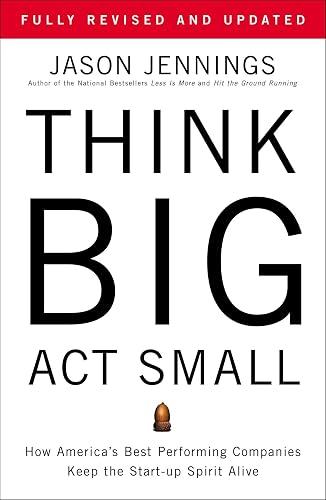
by Jason Jennings
Premium summary · Opens in the app · 30 min read
Every business leader wants growth. The question is what kind of growth, achieved how, and at what cost. Most companies chase growth through acquisitions, aggressive expansion, and relentless scaling. They believe bigger is always better. They assume that acting like a large, powerful corporation is the natural and desirable endpoint of success.
**Author:** Jason Jennings
**Estimated Reading Time:** 45 minutes
**What You'll Learn:** The nine core strategies that America's most consistently profitable companies use to achieve sustainable growth without losing their soul. You will discover why humility beats arrogance, why hands-on leadership outperforms detached management, and how thinking big while acting small creates lasting competitive advantage.
**Who This Book Is For:** Business leaders, entrepreneurs, managers, and anyone who wants to understand how great companies stay great. If you have ever wondered why some organizations thrive for decades while others flame out, this book provides the answer.
Every business leader wants growth. The question is what kind of growth, achieved how, and at what cost. Most companies chase growth through acquisitions, aggressive expansion, and relentless scaling. They believe bigger is always better. They assume that acting like a large, powerful corporation is the natural and desirable endpoint of success. Jason Jennings spent years studying a different kind of company. He and his research team identified the top-performing publicly traded companies in America, organizations that had increased revenue and profits by at least ten percent annually for ten consecutive years. They expected to find flashy headquarters, charismatic celebrity CEOs, and complex strategic frameworks. Instead, they found something entirely different. The leaders of these companies were humble. They avoided the spotlight. They worked in ordinary offices, sometimes no offices at all. They spent their time talking to customers, visiting stores, and working alongside employees. They did not have massive PR teams or corporate jets. They did not issue grandiose vision statements or host extravagant investor events. What they did have was a simple philosophy: think big, act small. This phrase became the title of Jennings's book and the organizing principle for everything he discovered. The companies he studied had ambitious goals. They wanted to grow, expand, and dominate their markets. But they pursued those goals with the humility, discipline, and hands-on approach of a small business. They never let their size or success go to their heads. The problem this book addresses is universal. Companies start out hungry, nimble, and close to their customers. Then success arrives. Revenue grows. Headcount expands. Offices get bigger. Leaders get further from the front lines. Bureaucracy creeps in. Arrogance follows. Before long, the company that once seemed unstoppable becomes slow, complacent, and vulnerable. This pattern repeats across industries and decades. It happened to General Motors, once the most powerful corporation in the world. It happened to Sears, once the largest retailer in America. It happened to countless others that grew big and started acting big. The companies Jennings studied avoided this fate. They grew big but never stopped acting small. Why does this matter now? Because the temptation to…
Continue reading in the MinuteRead app
Get the complete 30-minute summary of Think Big, Act Small
Get the complete summary in the appThink big, act small. Ambitious goals combined with humble, disciplined execution create sustainable growth.
Lead with humility. The best leaders are stewards, not celebrities.
Stay connected to the core business. Hands-on engagement keeps you informed and builds trust.
Focus on short-term execution while maintaining a long-term vision.
Let go of what is not working. Do not fall victim to the sunk cost fallacy.
Create an ownership culture where employees feel responsible for outcomes.
"Think Big, Act Small" is a strong fit if you want practical ideas around business, management, entrepreneurship, especially themes like think big, act small. ambitious goals combined with humble, disciplined execution create sustainable growth; lead with humility. the best leaders are stewards, not celebrities. The MinuteRead summary distills these concepts into a focused read, whether you're deciding whether to buy the book or applying its lessons at work.
Motivated to help readers with 1) Think Big, Jason Jennings wrote “Think Big, Act Small” to package those ideas for a fast, focused read. In “Think Big, Act Small”, Jason Jennings focuses on 1) Think Big. Through “Think Big, Act Small”, Jason Jennings distills the core ideas on business into lessons readers can absorb in a single short sitting. Readers turn to this work when they want Jason Jennings's perspective on the subject without working through the entire original volume. Jason Ryan Jenni…
Continue Reading
Access the complete 30-minute summary and thousands more nonfiction books in the MinuteRead app.

Continue reading the complete summary in the MinuteRead app.






