MinuteRead
5 min
Book summary
Premium summary · Opens in the app · 5 min read
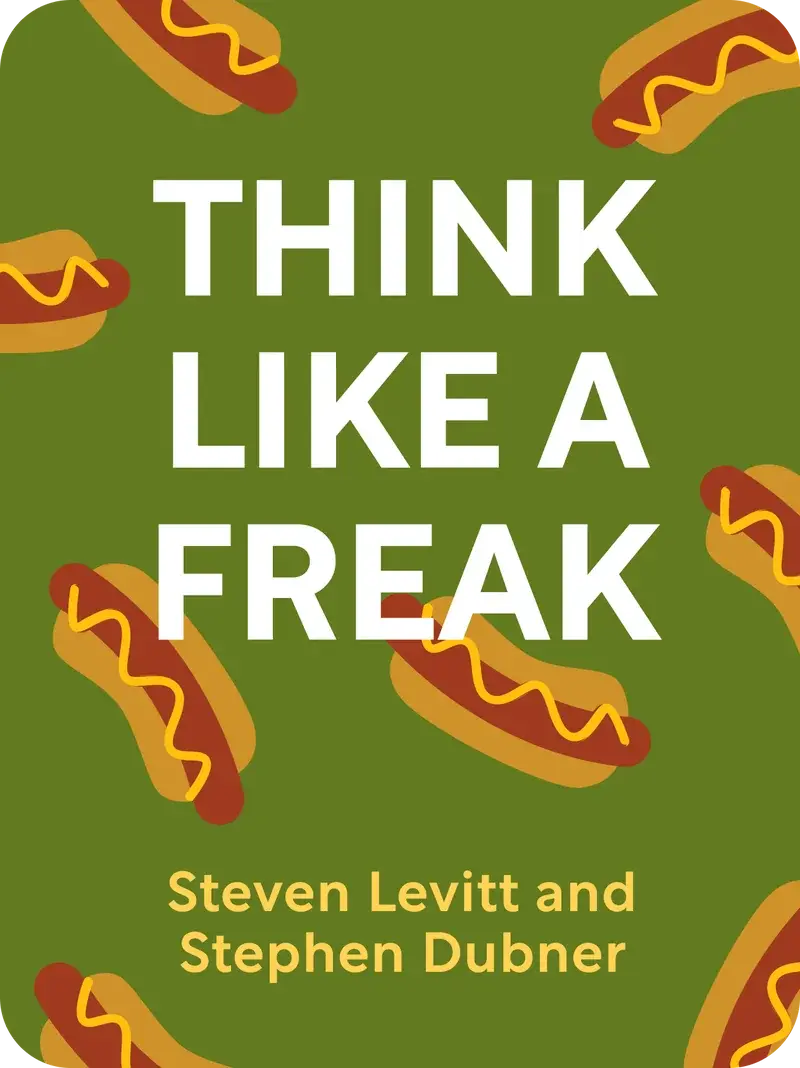
Think Like a Freak teaches you how to reject conventional wisdom as often as possible, ask the right questions about everything and come up with your own, statistically validated answers, instead of relying on other peoples’ opinions or common sense.
Think Like a Freak teaches you how to reject conventional wisdom as often as possible, ask the right questions about everything and come up with your own, statistically validated answers, instead of relying on other peoples’ opinions or common sense.
Let’s say I gave you a shot at winning the FIFA World Cup (soccer). All you have to do is make a penalty kick and score. One kick. All or nothing. Would you rather score a goal in a lame way and win or make a cool shot that your fans love, but lose?
You’ll probably say “Duh, Nik, of course I wanna win!” but the choice isn’t always as obvious.
Sometimes being right requires you to break with all conventions and that makes you unpopular. In order to think like a freak you have to accept that not everyone will like you, because you’re shaking up the world they know.
Sticking with the soccer example: If you do your homework and study the statistics of penalty kicks, you’ll see that goalkeepers jump to the kicker’s left side 57% of the time. Why? Because most soccer players are right-footed, which makes their kick to the left stronger. Goalkeepers only choose the right side 41% of the time.
But if you add up those numbers, this reveals something even more interesting. 57% + 41% = 98% – so what does the keeper do the other 2% of the time? He stays in the middle.
A kick in the middle is therefore always more likely to end in a goal. In fact, using Bayes’ Theorem you can calculate that it’s about 7% more likely to convert.
But a kick up the middle is one of the most boring, unsporting ways to make a penalty kick. It’s not spectacular, breaks the conventions and to some, feels like cheating. What’s more, if it doesn’t work, the goalkeeper will have caught the ball with zero effort – and the shooter’s fans will boo him.
Being right often means being disliked, but which one would you rather be – a disliked winner or a favored loser?
Psychologist and marketing professor Robert Cialdini (who wrote Influence) once did an interesting experiment. He wanted to find out what gets people to conserve energy at home (electricity, water, heat, etc.). Naturally, he started with a survey, asking people to rank a few factors by how much they thought they influenced their use of energy. The result: Wanting to protect the environment. Doing something that benefits society. Saving money. Doing it simply because other people do it too. Aww, that’s nice, isn’t it? A whole bunch of environmentally aware people, who care about society. Actually, not so much. To find…
Continue reading in the MinuteRead app
Get the complete 5-minute summary of Think Like A Freak
Get the complete summary in the appWould you rather be right or run-after?
To find better solutions to problems, observe how incentives actually impact human behavior in the real world.
Letting go of conventional wisdom will likely make you happier, because it’s often wrong anyways.
"Think Like A Freak" is a strong fit if you want practical ideas around creativity, business, economics, especially themes like would you rather be right or run-after?; to find better solutions to problems, observe how incentives actually impact human behavior in the real world. The MinuteRead summary distills these concepts into a focused read, whether you're deciding whether to buy the book or applying its lessons at work.
Steven D. Levitt teaches economics at the University of Chicago. His idiosyncratic economic research into areas as varied as guns and game shows has triggered debate in the media and academic circles.
View all summaries by Steven D. LevittContinue Reading
Access the complete 5-minute summary and thousands more nonfiction books in the MinuteRead app.

Continue reading the complete summary in the MinuteRead app.