MinuteRead
30 min
Book summary
by Norman Lewis
Premium summary · Opens in the app · 30 min read
There is a moment in every first meeting when the person across from you forms an impression. It happens quickly, often before you have finished your first sentence. That impression is not based on your ideas, your experience, or your character. It is based on your language.
**Author:** Norman Lewis
**Estimated Reading Time:** 45 minutes
**What You'll Learn:**
- Why your language announces who you are before you ever state an opinion - How vocabulary predicts career success more reliably than education level - A three-step method for turning unfamiliar words into permanent possessions - How Latin and Greek roots unlock hundreds of words at once - The 100 spelling demons behind 95 percent of all spelling errors - The three grammar trouble spots that cause 75 percent of common mistakes - Why "correct" English is whatever educated people actually use
**Who This Book Is For:**
Anyone who has ever felt uncertain about a word, hesitated before sending an email, or wondered whether they sounded as intelligent as they actually are. This book is for professionals who want their language to match their competence, for students who want to build lasting verbal skills, and for anyone who suspects their vocabulary and grammar are holding them back in ways they cannot quite see.
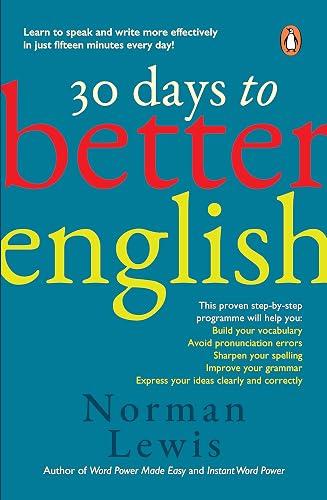
There is a moment in every first meeting when the person across from you forms an impression. It happens quickly, often before you have finished your first sentence. That impression is not based on your ideas, your experience, or your character. It is based on your language. Norman Lewis begins *Thirty Days to Better English* with an uncomfortable truth that most of us would rather avoid: people judge you not only by what you say but, more immediately, by how you say it. A misplaced accent, a doubled consonant in the wrong spot, an "irregardless" or a "between you and I" can yank a listener's attention away from your ideas and onto your error. Whether in a job interview, a written report, or casual conversation, your speech and writing continuously present you to friends, colleagues, and strangers. You are broadcasting a signal about your education, your attention to detail, and your mental habits whether you intend to or not. The problem is that most errors are invisible to the person making them. You cannot correct a mistake you do not know you are making. A person who says "libary" instead of "library" has been saying it that way for years. The error feels natural. It sounds right to their own ear. When they encounter the correct pronunciation, they may not even notice the difference. The same is true of spelling. A person who writes "seperate" instead of "separate" has written it that way hundreds of times. The misspelling looks normal to them. The correct spelling may even look wrong. This is the diagnostic function of Lewis's book. Across thirty short lessons of fifteen minutes each, he offers over a hundred self-tests on pronunciation, vocabulary, spelling,…
Continue reading in the MinuteRead app
Get the complete 30-minute summary of Thirty Days to Better English
Get the complete summary in the appYour language announces who you are. Every time you speak or write, you are presenting yourself to others.
Vocabulary predicts career success more reliably than education level. A richer word-stock enables richer reasoning.
Use the three-step method for new words: guess the meaning, check the dictionary, practice saying and writing.
Learn word roots. A single Latin or Greek root can unlock dozens of English words.
Target the 100 spelling demons that account for 95 percent of spelling errors. Use mnemonics to lock in correct forms.
Focus on the three grammar trouble spots: pronouns, lay/lie, and agreement. They account for 75 percent of mistakes.
"Thirty Days to Better English" is a strong fit if you want practical ideas around writing, language, self help, especially themes like your language announces who you are. every time you speak or write, you are presenting yourself to others; vocabulary predicts career success more reliably than education level. a richer word-stock enables richer reasoning. The MinuteRead summary distills these concepts into a focused read, whether you're deciding whether to buy the book or applying its lessons at work.
Motivated to turn hard-won expertise into something readers can use every day, Norman Lewis wrote “Thirty Days to Better English” to distill the ideas behind the work into clear, actionable lessons. Through “Thirty Days to Better English”, Norman Lewis distills the core ideas on writing into lessons readers can absorb in a single short sitting. Readers turn to this work when they want Norman Lewis's perspective on the subject without working through the entire original volume. The book is struct…
Continue Reading
Access the complete 30-minute summary and thousands more nonfiction books in the MinuteRead app.

Continue reading the complete summary in the MinuteRead app.