MinuteRead
30 min
Book summary
Premium summary · Opens in the app · 30 min read
We live in a world of things. Bridges carry us across rivers. Buildings shelter our work and our sleep. Airplanes lift us above clouds. Computers process our words and our calculations. We trust these things so completely that we rarely think about them. We walk across a bridge without considering the forces flowing through its cables. We ride an elevator without imagining the cables above our heads. We type on keyboards without wondering about the fatigue accumulating in the plastic beneath our
**Author:** Henry Petroski
**Estimated Reading Time:** 45 minutes
**What You'll Learn:**
- Why engineering failures are not anomalies but essential to progress - How the design process mirrors the creative process in writing and art - What famous collapses reveal about the nature of human error - Why factors of safety exist and how they evolve - How to think about risk, failure, and innovation in any field
**Who This Book Is For:**
Anyone who has ever wondered why bridges collapse, why buildings crack, or why the things we build sometimes fail despite our best efforts. This book is for the curious reader who wants to understand the hidden relationship between failure and progress, and for anyone who designs, builds, or creates anything at all.
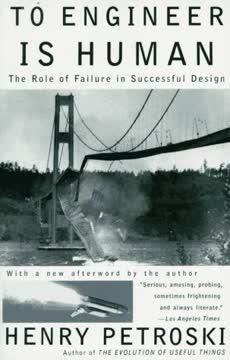
We live in a world of things. Bridges carry us across rivers. Buildings shelter our work and our sleep. Airplanes lift us above clouds. Computers process our words and our calculations. We trust these things so completely that we rarely think about them. We walk across a bridge without considering the forces flowing through its cables. We ride an elevator without imagining the cables above our heads. We type on keyboards without wondering about the fatigue accumulating in the plastic beneath our fingers. Most of the time, our trust is rewarded. The bridge holds. The elevator rises. The keyboard responds. But sometimes, sometimes, the thing fails. When a bridge collapses, we are shocked. When a building falls, we demand answers. When a plane crashes, we ask how such a thing could happen. We treat these failures as aberrations, as violations of the natural order of things. We assume that engineering is a precise science, that the people who design our world know exactly what they are doing, that failure should be impossible. Henry Petroski, a professor of civil engineering and history at Duke University, spent his career arguing that this assumption is fundamentally wrong. Engineering, he insisted, is not a precise science. It is a human endeavor, and like all human endeavors, it is subject to error. The things we build are not perfect because we are not perfect. The bridges that stand and the buildings that hold are not evidence of infallibility. They are evidence of learning, of iteration, of failure absorbed and transformed into knowledge. This book exists because understanding failure is essential to understanding engineering. And understanding engineering is essential to understanding the modern world. We are surrounded by the products of engineering, yet most of us have no idea how they work or why they sometimes fail. We are, in Petroski's words, "connoisseurs of chaos" without even knowing it, living in a world of order that is constantly threatened by disorder.…
Continue reading in the MinuteRead app
Get the complete 30-minute summary of To Engineer Is Human
Get the complete summary in the appEngineering is a human endeavor, subject to human error.
Failure is essential to progress. Every successful design is built on the lessons of designs that failed.
Every design is a hypothesis about how a structure will behave. The structure's performance is a test of that hypothesis
Design is an iterative process. The first design is a draft, to be evaluated and revised.
The factor of safety is a margin of error that accounts for uncertainty.
Cracks are common, and most are harmless, but some are signs of impending failure.
"To Engineer Is Human" is a strong fit if you want practical ideas around engineering, science, design, especially themes like engineering is a human endeavor, subject to human error; failure is essential to progress. every successful design is built on the lessons of designs that failed. The MinuteRead summary distills these concepts into a focused read, whether you're deciding whether to buy the book or applying its lessons at work.
Henry Petroski was a renowned American engineer and author who specialized in failure analysis. As a professor of civil engineering and history at Duke University, he brought a unique perspective to his work, combining technical expertise with historical context. Petroski wrote extensively on engineering and design, publishing numerous books that made complex concepts accessible to general readers. His approach often emphasized the importance of learning from failures to advance engineering prac…
View all summaries by Henry PetroskiContinue Reading
Access the complete 30-minute summary and thousands more nonfiction books in the MinuteRead app.

Continue reading the complete summary in the MinuteRead app.