 MinuteRead
30 min
Book summary
Premium summary · Opens in the app · 30 min read
"Facebook was founded in Mark Zuckerberg's Harvard University dorm room by Mark, his roommates, and friends.
**Author:** Perry Marshall
**Estimated Reading Time:** 45 minutes
**What You'll Learn:**
- Why Facebook became an advertising revolution despite never being designed for advertisers - How to target audiences with surgical precision and dramatically lower your ad costs - The psychological triggers that make people click, engage, and buy - How to master bidding strategies that save money while scaling results - How to build landing pages that convert casual browsers into customers - How to create a sustainable business that doesn't depend on any single platform
**Who This Book Is For:**
This book is for business owners, marketers, entrepreneurs, and anyone who wants to understand how Facebook advertising actually works. Whether you are spending your first hundred dollars or managing six-figure monthly budgets, the principles here apply. Perry Marshall wrote this guide for people who want results, not vanity metrics. If you are tired of throwing money at ads that do not perform, this book will show you why they fail and how to fix them.
Facebook was never supposed to be an advertising platform. When Mark Zuckerberg built the first version of Facebook in his Harvard dorm room, he was not thinking about cost per click, conversion rates, or return on ad spend. He was building a way for college students to connect with each other. The platform grew because it solved a human need: the desire to belong, to share, to be seen. Advertising was an afterthought, something that had to be figured out later once the platform had already captured the attention of billions. That accidental origin story matters more than most advertisers realize. It explains why Facebook advertising feels different from anything that came before it. Google built its empire on search intent. People type what they want, and Google shows them ads that match. The user is actively looking for something. Facebook is the opposite. People come to Facebook to socialize, to be entertained, to catch up with friends. They are not looking for your product. They are not in a buying mindset. They are scrolling through their news feed, and your ad is an interruption. This is why so many Facebook advertisers fail. They treat Facebook like a search engine. They write ads that assume the reader is already interested. They target broad audiences and hope for the best. Then they wonder why their cost per click is high and their conversion rate is terrible. Perry Marshall understood this problem early. He made his name in the world of Google AdWords, where he wrote one of the first and most influential books on pay-per-click advertising. When Facebook emerged as a serious advertising platform, Marshall saw that it required a fundamentally different approach. The…
Continue reading in the MinuteRead app
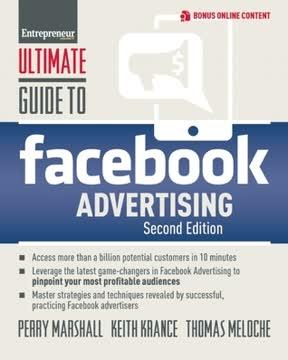
Get the complete 30-minute summary of Ultimate Guide to Facebook Advertising
Get the complete summary in the appFacebook advertising targets people based on identity, not intent.
Precise targeting is the key to efficiency and relevance.
The image determines 70% of your ad's effectiveness.
Start with CPC bidding, switch to CPM when CTR exceeds 1%.
Your landing page must match your ad and focus on a single goal.
Build a Facebook Page and post valuable content consistently.
"Ultimate Guide to Facebook Advertising" is a strong fit if you want practical ideas around business, social media, reference, especially themes like facebook advertising targets people based on identity, not intent; precise targeting is the key to efficiency and relevance. The MinuteRead summary distills these concepts into a focused read, whether you're deciding whether to buy the book or applying its lessons at work.
Perry Marshall is a renowned business consultant and author, endorsed by Forbes and Inc Magazine. He's known for integrating sales, technology, art, and psychology in his work. Marshall founded the $10 million Evolution 2.0 Prize and developed the 80/20 Curve used by NASA. His Google AdWords book pioneered the Pay Per Click industry, and he's served as an expert witness in search advertising litigation. With a background in Electrical Engineering, Marshall is respected for his honesty and expert…
View all summaries by Perry MarshallContinue Reading
Access the complete 30-minute summary and thousands more nonfiction books in the MinuteRead app.

Continue reading the complete summary in the MinuteRead app.






