MinuteRead
30 min
Book summary
by Karen Martin
Premium summary · Opens in the app · 30 min read
Most organizations do not actually know how work gets done. They know their job titles, their departmental responsibilities, and their individual tasks. They know the software systems they use and the reports they file. But ask a group of managers to describe what happens to a customer order from the moment it arrives to the moment it is fulfilled, and you will get conflicting answers, blank stares, and a lot of hand waving.
**Author:** Karen Martin **Estimated Reading Time:** 42 minutes
How to see your organization as a complete system rather than a collection of disconnected departments. You will learn to map how work actually flows from customer request to delivery, identify where delays and errors hide, design a better future state, and execute improvements with discipline. You will also learn why the mapping process itself changes how people think, often more powerfully than the map itself.
This book is for leaders, managers, and improvement practitioners who suspect their organization is working harder than necessary to deliver mediocre results. It is for anyone frustrated by long lead times, rework, miscommunication, and the feeling that every process improvement effort only rearranges problems rather than solving them. If you want a structured way to see the whole system and make meaningful change, this book will give you the tools.
Most organizations do not actually know how work gets done. They know their job titles, their departmental responsibilities, and their individual tasks. They know the software systems they use and the reports they file. But ask a group of managers to describe what happens to a customer order from the moment it arrives to the moment it is fulfilled, and you will get conflicting answers, blank stares, and a lot of hand waving. This is not because people are incompetent. It is because organizations have become so fragmented that no single person sees the whole. Sales knows what they sold. Operations knows what they produced. Finance knows what they billed. Customer service knows what they complained about. But the space between these functions, the handoffs, the waiting, the rework loops, the informal workarounds, belongs to no one. The result is predictable. Work takes far longer than it should. Errors multiply at the boundaries between departments. Customers wait. Employees burn out. Leaders implement improvement initiatives that target symptoms rather than causes. And the organization, despite everyone's best efforts, remains stuck. Value stream mapping exists to solve this problem. It is a method for making the invisible visible. It shows, on a single page, how work flows from the customer's initial request all the way through to delivery. It reveals where time is spent and where it is wasted. It exposes disconnects between what managers believe is happening and what actually happens on the ground. It creates a shared picture of reality that makes meaningful conversation possible. The origins of value stream mapping lie in manufacturing, specifically in the Toyota Production System. Toyota used maps of material and information flow to understand how value was created and where waste accumulated. Over time, the technique spread beyond the factory floor. Today, value stream mapping is used in healthcare, software…
Continue reading in the MinuteRead app
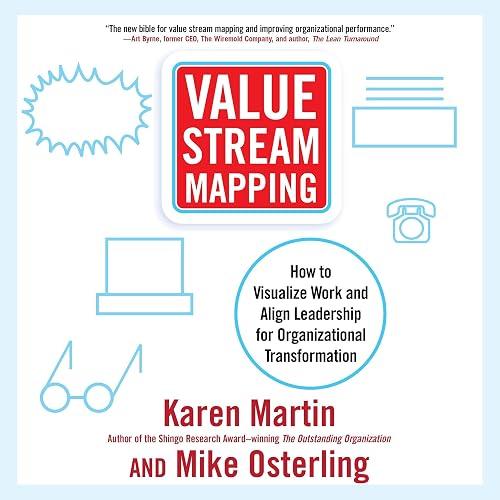
Get the complete 30-minute summary of Value Stream Mapping
Get the complete summary in the appValue stream mapping shows how work actually flows from customer request to delivery, revealing waste and delays that ar
You cannot map a value stream from a conference room. You must go to the gemba and observe the work directly.
The three key metrics are Process Time, Lead Time, and Percent Complete and Accurate. Together, they reveal efficiency,
The current state map documents reality, not assumptions. It is the foundation for everything that follows.
The future state map provides a clear target for improvement, with specific countermeasures and measurable targets.
The transformation plan converts insight into action, with clear owners and timelines for every improvement.
"Value Stream Mapping" is a strong fit if you want practical ideas around business, management, leadership, especially themes like value stream mapping shows how work actually flows from customer request to delivery, revealing waste and delays that ar; you cannot map a value stream from a conference room. you must go to the gemba and observe the work directly. The MinuteRead summary distills these concepts into a focused read, whether you're deciding whether to buy the book or applying its lessons at work.
Motivated to help readers with value stream mapping becomes an important step in using the Plan-Do-Study-Adjust (PDSA) cycle to solve, Karen Martin wrote “Value Stream Mapping” to package those ideas for a fast, focused read. In “Value Stream Mapping”, Karen Martin focuses on value stream mapping becomes an important step in using the Plan-Do-Study-Adjust (PDSA) cycle to solve. Through “Value Stream Mapping”, Karen Martin distills the core ideas on business into lessons readers can absorb in a s…
Continue Reading
Access the complete 30-minute summary and thousands more nonfiction books in the MinuteRead app.

Continue reading the complete summary in the MinuteRead app.