 MinuteRead
30 min
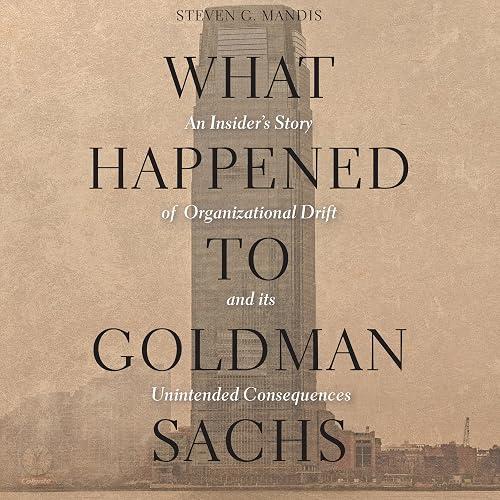
Book summary
by Steven G. Mandis
Premium summary · Opens in the app · 30 min read
In the autumn of 2008, as the global financial system teetered on the edge of collapse, one institution stood apart. While Bear Stearns vanished, Lehman Brothers filed for bankruptcy, and Merrill Lynch sold itself in desperation, Goldman Sachs not only survived but emerged stronger. The firm that had once been a modest partnership of Jewish immigrants had become the most powerful bank on Wall Street, admired and envied in equal measure.
**Author:** Steven G. Mandis
**Estimated Reading Time:** 45 minutes
**What You'll Learn:** How one of the world's most respected financial institutions drifted from its founding principles, why organizational culture changes even at the most successful companies, and what leaders can do to prevent the slow erosion of values that leads to institutional failure.
**Who This Book Is For:** Anyone interested in organizational culture, financial history, corporate ethics, or the forces that reshape institutions over time. This book speaks to leaders, investors, students of business, and readers curious about how Wall Street transformed from a relationship-driven world to a transaction-driven one.
In the autumn of 2008, as the global financial system teetered on the edge of collapse, one institution stood apart. While Bear Stearns vanished, Lehman Brothers filed for bankruptcy, and Merrill Lynch sold itself in desperation, Goldman Sachs not only survived but emerged stronger. The firm that had once been a modest partnership of Jewish immigrants had become the most powerful bank on Wall Street, admired and envied in equal measure. Yet something strange accompanied this triumph. The same firm that navigated the crisis better than its peers found itself summoned before Congress, accused of betting against its own clients, and lampooned in the press as a "great vampire squid wrapped around the face of humanity." How could an institution so successful be so reviled? How could a firm built on the principle that "our clients' interests always come first" be accused of systematically exploiting those same clients? Steven G. Mandis spent twelve years at Goldman Sachs, from 1992 to 2004, working in the equities division and later in the firm's proprietary trading operations. He lived the culture, absorbed its values, and believed in its principles. After leaving to co-found his own asset management firm, he became a client of Goldman, experiencing the institution from the outside. This dual perspective, insider and outsider, gave him a unique vantage point from which to observe something troubling: the Goldman Sachs he knew as an employee was not the Goldman Sachs he encountered as a client. The difference was subtle at first. Small changes in how people communicated. A shift in priorities. A growing emphasis on transactions over relationships. Mandis began to wonder whether the firm's famous culture, the secret sauce that had made Goldman the gold standard of Wall Street, was eroding. Was the firm still living by its principles, or had those principles become mere words on a website? This book is Mandis's attempt to answer that question. It is not a polemic or an exposé. It is a careful, analytical examination of how organizational culture changes, how success can sow the seeds of future failure, and how even the most…
Continue reading in the MinuteRead app
Get the complete 30-minute summary of What Happened to Goldman Sachs
Get the complete summary in the appOrganizational culture is shaped by structure and incentives, not just values and mission statements.
Goldman's partnership structure aligned the firm's interests with its clients' interests, creating a powerful competitiv
The IPO changed Goldman's ownership structure, shifting risk and shortening the firm's time horizon.
The shift from advisory work to trading changed Goldman's relationship with clients, creating new conflicts of interest.
Goldman's first business principle was reinterpreted from an ethical standard to a legal standard over time.
Organizational drift is the gradual, invisible process by which culture changes over time.
"What Happened to Goldman Sachs" is a strong fit if you want practical ideas around business, finance, history, especially themes like organizational culture is shaped by structure and incentives, not just values and mission statements; goldman's partnership structure aligned the firm's interests with its clients' interests, creating a powerful competitiv. The MinuteRead summary distills these concepts into a focused read, whether you're deciding whether to buy the book or applying its lessons at work.
Motivated to help readers with our clients’ interests always come first, Steven G. Mandis wrote “What Happened to Goldman Sachs” to package those ideas for a fast, focused read. Through “What Happened to Goldman Sachs”, Steven G. Mandis distills the core ideas on business into lessons readers can absorb in a single short sitting. Readers turn to this work when they want Steven G. Mandis's perspective on the subject without working through the entire original volume. The book is structured so eac…
Continue Reading
Access the complete 30-minute summary and thousands more nonfiction books in the MinuteRead app.

Continue reading the complete summary in the MinuteRead app.






