MinuteRead
30 min
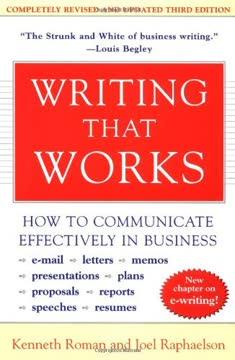
Every day, millions of people sit down to write something at work. A memo. An email. A proposal. A presentation. A report. And every day, millions of those documents fail to accomplish what they were meant to accomplish.
**Author:** Kenneth Roman (with Joel Raphaelson)
**Estimated Reading Time:** 45 minutes
**What You'll Learn:** How to write with clarity, persuasion, and impact in every professional context. You will learn how to structure memos that get read, craft emails that get answered, write proposals that win approval, create resumes that open doors, and deliver presentations that hold attention.
**Who This Book Is For:** Anyone who writes at work. Whether you are a recent graduate sending your first cover letter, a manager trying to get a budget approved, or an executive communicating strategy to a board, the principles in this book will make your writing sharper, faster, and more effective.
Every day, millions of people sit down to write something at work. A memo. An email. A proposal. A presentation. A report. And every day, millions of those documents fail to accomplish what they were meant to accomplish. The problem is rarely a lack of intelligence or good intentions. The problem is that most people were never taught how to write for the business world. They learned to write in school, where longer sentences and bigger words often earned higher grades. They learned to write for teachers who were paid to read their work. Then they entered a professional world where nobody is paid to read anything. In business, readers are busy, distracted, and impatient. They scan. They skim. They delete. They move on. Kenneth Roman spent decades at the highest levels of corporate communication. As chairman and CEO of Ogilvy & Mather Worldwide, one of the most respected advertising agencies in history, he saw firsthand what happens when writing works and what happens when it does not. He watched brilliant ideas die in poorly written memos. He watched mediocre ideas win approval because they were presented with clarity and conviction. He learned that in the professional world, the quality of your writing is often indistinguishable from the quality of your thinking. This book exists because writing is not a soft skill. It is a hard business tool. When your writing is unclear, decisions get delayed. When your writing is unfocused, resources get misallocated. When your writing is unconvincing, good ideas go nowhere. The cost of bad writing is enormous, but it is rarely measured. Meetings are called to clarify what a memo should have made clear. Projects stall because instructions were ambiguous. Deals fall apart because proposals failed to persuade. The author's approach is different because it comes from the world of advertising, where the stakes are brutally clear. In advertising, if your writing does not work, you lose the account. There is no room for self-indulgence. Every word must earn its place. Every sentence must move the reader toward action.…
Continue reading in the MinuteRead app
Get the complete 30-minute summary of Writing That Works
Get the complete summary in the appKnow what you want to say before you start writing.
Put your main point first, not last.
Use simple words and short sentences.
Prefer active voice over passive voice.
Be specific. Use numbers and concrete examples.
Structure your writing with clear headings and topic sentences.
"Writing That Works" is a strong fit if you want practical ideas around writing, business, self help, especially themes like know what you want to say before you start writing; put your main point first, not last. The MinuteRead summary distills these concepts into a focused read, whether you're deciding whether to buy the book or applying its lessons at work.
Kenneth Roman is a former chairman and CEO of Ogilvy & Mather Worldwide, a leading advertising agency. He co-authored Writing That Works with Joel Raphaelson, drawing on their extensive experience in corporate communications. Roman's background in advertising and business leadership informed the book's practical approach to effective writing. He has also written other books on business and advertising, including "The King of Madison Avenue: David Ogilvy and the Making of Modern Advertising." Rom…
View all summaries by Kenneth RomanContinue Reading
Access the complete 30-minute summary and thousands more nonfiction books in the MinuteRead app.

Continue reading the complete summary in the MinuteRead app.