 MinuteRead
30 min
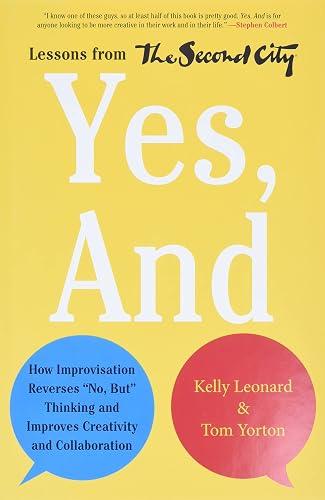
Book summary
by Kelly Leonard
Premium summary · Opens in the app · 30 min read
The business world has a listening problem. Not the kind measured in surveys or focus groups, but a deeper failure: the inability to truly hear what colleagues, customers, and markets are saying in real time. Companies spend millions trying to predict the future while ignoring the signals already present in their own conference rooms. They hire brilliant people and then structure meetings so those people never build on each other's ideas. They claim to value innovation while punishing the very f
**Author:** Kelly Leonard with Tom Yorton **Estimated Reading Time:** 45 minutes
How the core principles of improvisational comedy can transform the way you lead teams, navigate uncertainty, collaborate with others, and unlock creative potential in any professional environment. You'll discover why the simple phrase "Yes, And" holds the key to innovation, why ensembles outperform teams, and how embracing failure can become your greatest competitive advantage.
This book is for leaders who feel stuck in hierarchical thinking, professionals who want to contribute more creatively, entrepreneurs navigating constant change, and anyone who has ever sat in a meeting watching good ideas die from a thousand "yes, but" cuts. If you suspect that the old rules of command-and-control leadership no longer work, this book will show you what comes next.
The business world has a listening problem. Not the kind measured in surveys or focus groups, but a deeper failure: the inability to truly hear what colleagues, customers, and markets are saying in real time. Companies spend millions trying to predict the future while ignoring the signals already present in their own conference rooms. They hire brilliant people and then structure meetings so those people never build on each other's ideas. They claim to value innovation while punishing the very failures that make innovation possible. Kelly Leonard has spent over three decades at The Second City, the Chicago comedy institution that launched the careers of Tina Fey, Stephen Colbert, Amy Poehler, Keegan-Michael Key, and countless others. What he observed there was not just a formula for making people laugh. It was a fundamentally different way of working together, one built on principles that directly contradict how most organizations operate. The central insight is deceptively simple. In improvisation, performers are trained to accept whatever their scene partner offers and then build upon it. This is the "Yes, And" principle. When someone says "I'm a doctor," you don't respond with "No, you're a plumber." You say "Yes, and I'm your patient who hasn't slept in three days." Every line becomes an opportunity to advance the scene. Every offer becomes a gift. Now consider how most business meetings function. Someone proposes an idea. A colleague immediately identifies why it won't work. Another person suggests a modification that fundamentally changes the concept. A senior leader asks a question that subtly signals disapproval. The idea dies, not because it was bad, but because it never received the collaborative energy needed to develop into something useful. The difference between these two environments is not talent. It is structure. Improvisers work within a framework that demands acceptance and building. Business professionals typically work within a framework that rewards criticism and caution. Both frameworks produce predictable results. What makes The Second…
Continue reading in the MinuteRead app
Get the complete 30-minute summary of Yes, And
Get the complete summary in the app**"Yes, And" is the foundation of innovation.** Accept ideas and build on them before evaluating. Give every idea a chan
**Build ensembles, not teams.** Prioritize collective success over individual achievement. Rotate roles, share credit, a
**Listen deeply, not just actively.** Use what you hear as raw material for building. Wait until others finish before re
**Co-create with your audience.** Treat customers as partners in development. Engage in dialogue rather than monologue.
**Use comedy to navigate change.** Acknowledge difficult truths with humor. Laugh at shared frustrations, not individual
**Embrace failure as fuel.** Create safe spaces for experimentation. Distinguish productive failure from wasteful failur
"Yes, And" is a strong fit if you want practical ideas around business, leadership, self help, especially themes like **"yes, and" is the foundation of innovation.** accept ideas and build on them before evaluating. give every idea a chan; **build ensembles, not teams.** prioritize collective success over individual achievement. rotate roles, share credit, a. The MinuteRead summary distills these concepts into a focused read, whether you're deciding whether to buy the book or applying its lessons at work.
Motivated to help readers with with Yes, Kelly Leonard wrote “Yes, And” to package those ideas for a fast, focused read. In “Yes, And”, Kelly Leonard focuses on with Yes. Through “Yes, And”, Kelly Leonard distills the core ideas on business into lessons readers can absorb in a single short sitting. Readers turn to this work when they want Kelly Leonard's perspective on the subject without working through the entire original volume. Kelly Leonard (born 1966) is an author, public speaker and theat…
Continue Reading
Access the complete 30-minute summary and thousands more nonfiction books in the MinuteRead app.

Continue reading the complete summary in the MinuteRead app.






