MinuteRead
30 min
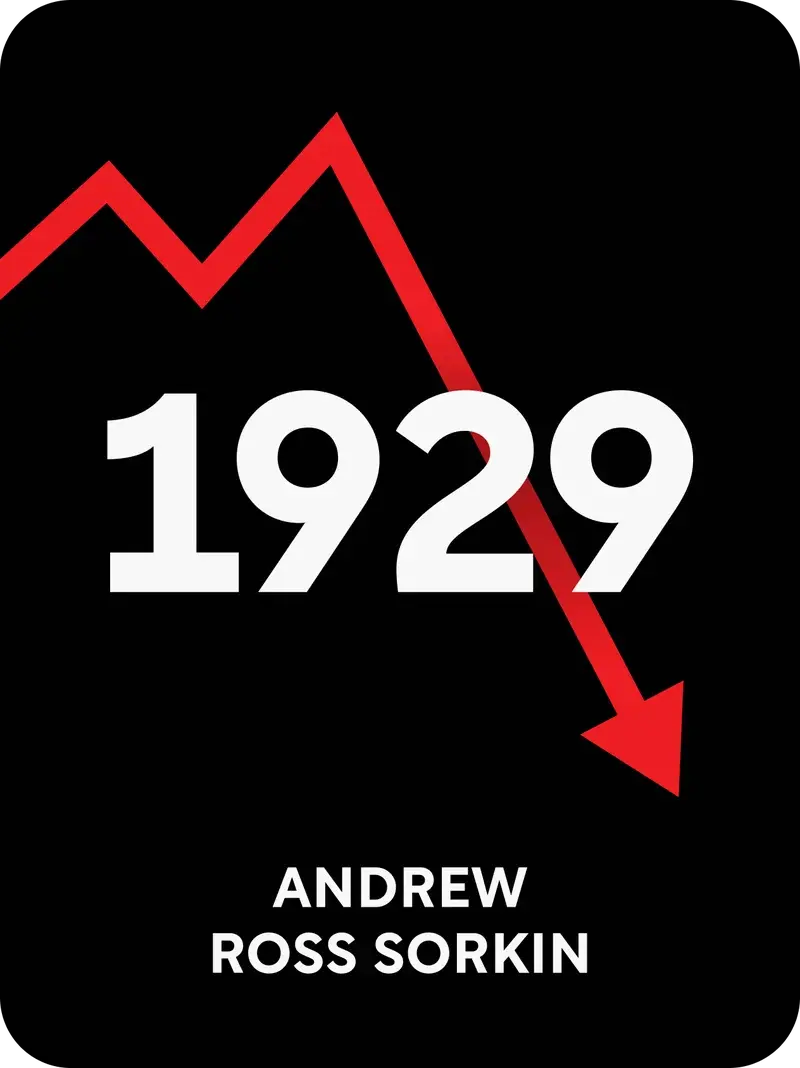
The stock market crash of 1929 occupies a strange place in American memory. Everyone knows it happened. Most people know it led to the Great Depression. But few understand what actually occurred during those chaotic weeks in October, who the central figures were, or why the machinery of American finance failed so completely.
**Author:** Andrew Ross Sorkin
**Estimated Reading Time:** 45 minutes
**What You'll Learn:** How the 1929 stock market crash unfolded, why it happened, who the key players were, and what the crash reveals about the psychology of financial booms and busts. You will understand the mechanics of margin lending, stock pools, and investment trusts, and you will see how the regulatory reforms that followed reshaped American capitalism.
**Who This Book Is For:** Anyone who wants to understand financial history, investors seeking perspective on market cycles, readers curious about the origins of modern Wall Street, and anyone who has ever wondered whether "this time is different."
The stock market crash of 1929 occupies a strange place in American memory. Everyone knows it happened. Most people know it led to the Great Depression. But few understand what actually occurred during those chaotic weeks in October, who the central figures were, or why the machinery of American finance failed so completely. Andrew Ross Sorkin set out to change that. In this book, he reconstructs the crash not as a distant historical event but as a human drama filled with ambition, hubris, miscalculation, and occasional heroism. The result is a story that feels uncomfortably contemporary. The problem Sorkin addresses is not simply historical ignorance. It is the persistent myth that financial crises are unpredictable acts of nature, like earthquakes or hurricanes. The reality, as he demonstrates, is far more troubling. The 1929 crash was not inevitable. It was the product of specific decisions made by identifiable people operating within a system that encouraged recklessness while discouraging restraint. Why does this matter today? Because the patterns that produced 1929 have reappeared in every subsequent financial crisis. The dot-com bubble of the late 1990s. The housing bubble of the mid-2000s. The cryptocurrency mania of recent years. Each era produces its own vocabulary for describing the same underlying phenomena: excessive leverage, widespread speculation, regulatory paralysis, and the unshakable conviction that the old rules no longer apply. People struggle with this history because it is genuinely complex. The crash involved margin accounts and call money rates, investment trusts and stock pools, Federal Reserve politics and Senate investigations. It is easier to reduce the story to a simple morality tale about greed and punishment. But that simplification obscures the most important lessons. What makes Sorkin's approach different is his focus on the people. He does not write about abstract market forces. He writes about Charles Mitchell, the charismatic banker who defied the Federal Reserve and was celebrated as a hero before becoming a scapegoat. He writes about Irving Fisher, the brilliant Yale economist who insisted stocks had reached a "permanently high plateau" just weeks before the collapse. He writes about…
Continue reading in the MinuteRead app
Get the complete 30-minute summary of 1929
Get the complete summary in the appConfidence disappears gradually, then suddenly. The crash was not a single event but a process that unfolded over months
Credit amplifies both gains and losses. Margin lending created a system in which falling prices triggered forced selling
When everyone is invested, there is no one left to buy. The presence of bootblacks and professors in the market was a wa
Short-term rescue can create long-term problems. Charles Mitchell's intervention in March made the October crash worse.
The crash did not cause the Depression. The credit freeze did. When banks stopped lending, the economy contracted.
Experts are subject to the same biases as everyone else. Irving Fisher and Thomas Lamont were brilliant and catastrophic
"1929" is a strong fit if you want practical ideas around history, economics, business, especially themes like confidence disappears gradually, then suddenly. the crash was not a single event but a process that unfolded over months; credit amplifies both gains and losses. margin lending created a system in which falling prices triggered forced selling. The MinuteRead summary distills these concepts into a focused read, whether you're deciding whether to buy the book or applying its lessons at work.
Andrew Ross Sorkin is a prominent financial journalist and author. He serves as The New York Times' chief mergers and acquisitions reporter and columnist, as well as the editor of DealBook, an online financial report. Sorkin is recognized for his expertise on Wall Street and corporate America, contributing to the paper's business and finance coverage. He has received numerous accolades, including a Gerald Loeb Award and Society of American Business Editors and Writers Awards. Sorkin frequently a…
View all summaries by Andrew Ross SorkinContinue Reading
Access the complete 30-minute summary and thousands more nonfiction books in the MinuteRead app.

Continue reading the complete summary in the MinuteRead app.