MinuteRead
30 min
Book summary
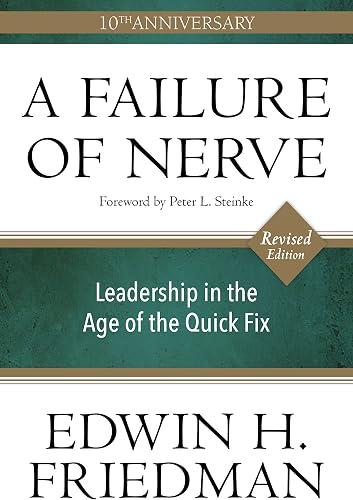
by Edwin H. Friedman
Premium summary · Opens in the app · 30 min read
Every generation believes it is living through unprecedented times. But Edwin Friedman argued that the defining crisis of our era is not technological, economic, or political. It is emotional. He called it a failure of nerve.
**Author:** Edwin H. Friedman
**Estimated Reading Time:** 45 minutes
**What You'll Learn:** Why anxiety, not lack of information, is the central obstacle to leadership and growth. You will learn how emotional systems operate, why self-differentiation matters more than technique, and how to lead with clarity in the face of resistance.
**Who This Book Is For:** Leaders, parents, educators, executives, clergy, and anyone who has ever tried to create change in a group that seemed determined to resist it. If you have ever felt that your competence was not the problem, that something deeper was blocking progress, this book will explain what that something is.
Every generation believes it is living through unprecedented times. But Edwin Friedman argued that the defining crisis of our era is not technological, economic, or political. It is emotional. He called it a failure of nerve. Friedman was a rabbi, a family therapist, and a leadership consultant who spent decades working with families, congregations, and organizations. Across all these settings, he noticed something striking. The problems people faced were rarely caused by a lack of information. They were caused by an inability to act on what they already knew. People knew what needed to be done. They simply could not bring themselves to do it. The reason, Friedman argued, is anxiety. Not ordinary stress, but chronic anxiety: a pervasive, self-reinforcing state of reactivity that spreads through families, institutions, and entire societies. When chronic anxiety takes hold, people stop thinking clearly. They become reactive instead of reflective. They seek comfort instead of challenge. They prioritize togetherness over truth. And they demand that leaders make them feel better rather than help them grow. This book was published posthumously in 2007, but Friedman had been developing its ideas for decades. His work drew on the field of family systems theory, particularly the insights of Murray Bowen, who showed that families operate as emotional units rather than collections of independent individuals. Friedman extended this insight beyond the family to congregations, corporations, and nations. He believed that the same emotional forces that shape a family dinner table also shape a boardroom, a church council, and a national electorate. The title comes from a phrase used by historians to describe periods when a civilization loses its confidence and turns inward. The Renaissance, Friedman notes, was not primarily a technological or intellectual revolution. It was an emotional one. After centuries of stagnation, a handful of individuals found the nerve to challenge established authority and explore the unknown. They did not have more information than their predecessors. They had more courage. Friedman believed that contemporary society was experiencing a similar failure of nerve. We have more data, more expertise, and more communication technology than…
Continue reading in the MinuteRead app
Get the complete 30-minute summary of A Failure of Nerve
Get the complete summary in the appChronic anxiety, not lack of information, is the primary obstacle to growth and change.
Self-differentiation is the capacity to maintain your own identity and principles while staying connected to others.
Leadership is about presence, not technique. Who you are matters more than what you do.
Empathy without responsibility enables dysfunction. Hold people accountable.
The obsession with data is a symptom of anxiety. Have the courage to decide with incomplete information.
Emotional triangles are the basic building blocks of relationship systems. Stay out of them.
"A Failure of Nerve" is a strong fit if you want practical ideas around leadership, business, psychology, especially themes like chronic anxiety, not lack of information, is the primary obstacle to growth and change; self-differentiation is the capacity to maintain your own identity and principles while staying connected to others. The MinuteRead summary distills these concepts into a focused read, whether you're deciding whether to buy the book or applying its lessons at work.
Motivated to help readers with the great thing to remember is that the mind of man cannot be enlightened permanently by merely teaching him, Edwin H. Friedman wrote “A Failure of Nerve” to package those ideas for a fast, focused read. In “A Failure of Nerve”, Edwin H. Friedman focuses on the great thing to remember is that the mind of man cannot be enlightened permanently by merely teaching him. Through “A Failure of Nerve”, Edwin H. Friedman distills the core ideas on leadership into lessons re…
Continue Reading
Access the complete 30-minute summary and thousands more nonfiction books in the MinuteRead app.

Continue reading the complete summary in the MinuteRead app.