MinuteRead
5 min
Book summary
Premium summary · Opens in the app · 5 min read
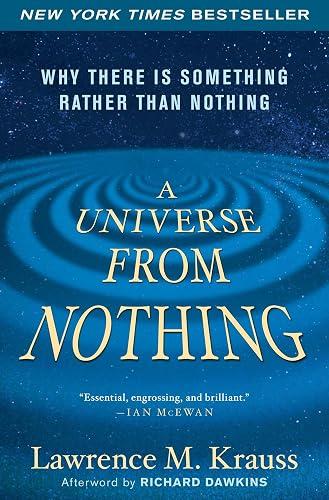
A Universe From Nothing will enlarge your knowledge of our expanding universe by showing you how it began, what we’re learning about it now, and what will happen to it in the future.
A Universe From Nothing will enlarge your knowledge of our expanding universe by showing you how it began, what we’re learning about it now, and what will happen to it in the future.
Everything we know began in the big bang 14 billion years ago. A lot has happened since then, including a lot of expansion of human knowledge about outer space. We’ve come a long way since thinking that the Earth was the center of our solar system!
Today we know through observation that our universe is expanding. Physicist George Lemaitre predicted that the theory of relativity that came from Einstein meant that our universe was not stationary but growing. Even Einstein rejected this theory, but not long after he was corrected by observation.
To understand how scientists figured this out, you need to know about the Doppler Effect. If you’re sitting somewhere that you can hear the cars going by, you’ll notice that the noise a car makes is different as it moves past you. Take a moment and try it out yourself, it’s pretty interesting!
Research confirms that this same effect happens with light. Objects that are moving away from us have different shades of color than those heading in our direction. In observation of the colors that celestial bodies have, researchers found that almost everything in our universe is moving away from us. Looking more closely, they’ve discovered that the farther away an object is, it is moving away more rapidly. This confirms the theory that our universe is expanding faster.
So we know that the universe is expanding, but what is causing this? Just as blowing a balloon up requires air, so does our universe have a force pushing it outward. The trouble is, there’s nothing we can observe that’s causing this. Physicists thus call this force in empty space “dark” energy. But they still can’t explain where this propelling force comes from or even what it really is. In addition to this mysterious energy, scientists have also discovered that most of the universe is invisible. They call this dark matter, but that’s a little confusing because we can’t see it. A better way to think of this unknown substance is invisible matter due to the fact that it’s not visible to any of our instruments. So how did we discover these strange pieces of our universe? Calculations to determine the rotation rate of our universe show that there must be more mass than we can see. In other words, the observable universe just isn’t heavy enough to cause the speed at which we are rotating. Thus, invisible matter must exist. Next time you look up at the night sky and see the darkness between…
Continue reading in the MinuteRead app
Get the complete 5-minute summary of A Universe From Nothing
Get the complete summary in the appOur universe is expanding and doing so faster each day.
Dark energy and dark matter fill what we think of as emptiness between what we can see in our universe.
Although we can currently see neighboring and even distant galaxies, eventually our expanding universe will make this impossible.
"A Universe From Nothing" is a strong fit if you want practical ideas around future, history, science, especially themes like our universe is expanding and doing so faster each day; dark energy and dark matter fill what we think of as emptiness between what we can see in our universe. The MinuteRead summary distills these concepts into a focused read, whether you're deciding whether to buy the book or applying its lessons at work.
I was born in New York City and shortly afterward moved to Toronto, spending my childhood in Canada. I received undergraduate degrees in mathematics and physics from Carleton University in Ottawa Canada, and my Ph.D. from the Massachusetts Institute of Technology in 1982. After three year a stint in the Harvard Society of Fellows, I was a professor at Yale University for eight years and then, when I was 38 I moved to become Ambrose Swasey Professor of Physics, professor of astronomy, and Chairm…
View all summaries by Lawrence M. KraussContinue Reading
Access the complete 5-minute summary and thousands more nonfiction books in the MinuteRead app.

Continue reading the complete summary in the MinuteRead app.