MinuteRead
30 min
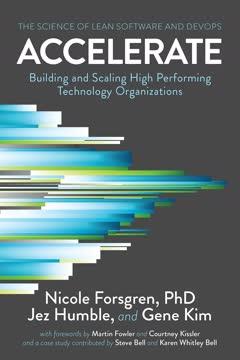
For decades, the software industry operated on a foundation of folklore. Consultants sold frameworks. Vendors sold tools. Thought leaders sold methodologies. But almost no one could answer a simple question with any rigor: what actually works?
**Author:** Nicole Forsgren, PhD, with Jez Humble and Gene Kim
**Estimated Reading Time:** 45 minutes
**What You'll Learn:**
- Why software delivery capability is now the single most important predictor of organizational performance - The four key metrics that separate elite technology organizations from laggards - How culture, architecture, and leadership combine to enable high performance - Practical capabilities you can implement immediately to transform your technology organization - Why speed and stability are not trade-offs, but mutually reinforcing outcomes
**Who This Book Is For:**
Technology leaders who want to move beyond opinion and anecdote. Engineering managers tired of cargo cult transformations. Executives who need evidence-based guidance for technology investment. Anyone who has ever wondered why some software organizations consistently outperform others despite similar resources, talent, and market conditions.
For decades, the software industry operated on a foundation of folklore. Consultants sold frameworks. Vendors sold tools. Thought leaders sold methodologies. But almost no one could answer a simple question with any rigor: what actually works? The result was predictable. Organizations lurched from one transformation initiative to the next. They adopted agile ceremonies without agile principles. They rebranded operations teams as DevOps teams without changing how work flowed. They invested millions in tooling while their delivery performance remained stubbornly flat. And through it all, they had no reliable way to know whether any of their efforts were making things better or worse. This book exists because that situation is no longer acceptable. The authors spent four years conducting one of the largest and most rigorous research programs ever undertaken in the software industry. They surveyed more than 23,000 professionals across thousands of organizations worldwide. They applied statistical methods drawn from the social and organizational sciences. They tested hypotheses, controlled for confounding variables, and published their findings in peer-reviewed venues. What emerged was something the software industry had never had before: a body of evidence showing which capabilities actually drive performance, and which ones do not. The findings were striking. Software delivery performance matters enormously to organizational outcomes. High performers are twice as likely to exceed their profitability, market share, and productivity goals as low performers. They are twice as likely to achieve their organizational mission, whether commercial or non-commercial. And they do this while simultaneously delivering higher quality software, experiencing less burnout, and creating cultures that attract and retain talent. Perhaps most importantly, the research demolished one of the most persistent myths in technology management: the idea that speed and stability are in tension. The data showed the opposite. Organizations that deploy frequently also restore service faster when incidents occur. Organizations that embrace automation also reduce their change failure rate. The capabilities that enable speed are the same capabilities that enable…
Continue reading in the MinuteRead app
Get the complete 30-minute summary of Accelerate
Get the complete summary in the appSoftware delivery performance predicts organizational performance. It is the single most important predictor of business
Measure the four key metrics: delivery lead time, deployment frequency, time to restore service, and change fail rate. T
Speed and stability are not trade-offs. The capabilities that enable speed also enable stability. Invest in those capabi
Continuous delivery is the foundational technical capability. It enables both speed and stability by making deployments
Loosely coupled architecture enables teams to work independently and deploy independently. This is essential for scaling
Generative culture drives performance. Cultures characterized by cooperation, shared risk, and a focus on mission outper
"Accelerate" is a strong fit if you want practical ideas around business, technology, management, especially themes like software delivery performance predicts organizational performance. it is the single most important predictor of business; measure the four key metrics: delivery lead time, deployment frequency, time to restore service, and change fail rate. t. The MinuteRead summary distills these concepts into a focused read, whether you're deciding whether to buy the book or applying its lessons at work.
Nicole Forsgren PhD is an expert in DevOps and IT organizational performance. She is known for her work on the annual State of DevOps Report and her research on high-performing technology organizations. Forsgren has a background in management information systems and is recognized for her ability to apply rigorous research methods to practical business problems. Her work focuses on using data to drive decision-making and improve software delivery and organizational outcomes. Forsgren has collabor…
View all summaries by Nicole ForsgrenContinue Reading
Access the complete 30-minute summary and thousands more nonfiction books in the MinuteRead app.

Continue reading the complete summary in the MinuteRead app.