MinuteRead
5 min
Book summary
by Mark Levy
Premium summary · Opens in the app · 5 min read
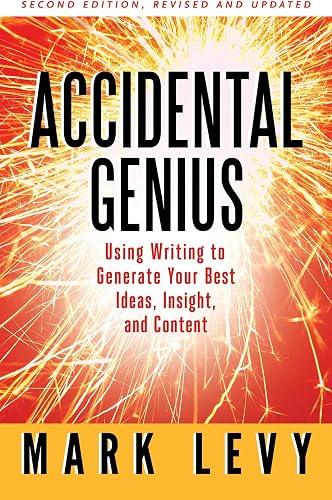
Accidental Genius introduces you to the concept of freewriting, which you can use to solve complex problems, exercise your creativity, flesh out your ideas and even build a catalog of publishable work.
Accidental Genius introduces you to the concept of freewriting, which you can use to solve complex problems, exercise your creativity, flesh out your ideas and even build a catalog of publishable work.
Warren Buffett likes to joke that the secret to a happy marriage is low expectations. I’m not sure about that, but for freewriting it sure sets the right context. The whole point of the exercise is to get ideas flowing, so perfectionism would only get in the way. Before you start a stream-of-consciousness session, relax, remember it’s no pressure and put yourself in a 90% mindset, rather than 110%.
The second key to a successful freewriting session is writing quickly and coherently. Don’t stop. Don’t edit. Never question your statements. Repeat lines if it helps you keep moving. Focus on quantity over quality.
Lastly, and this helps with the second point, set a time limit. Whether it’s an alarm, the wait for your coffee brewer or a washing machine cycle, a fixed start and end point will help you focus and move fast.
So, for a good, first freewriting session:
Lower your expectations. Write fast and fluidly. Set a time limit – 5 to 20 minutes will do just fine.
Reality, psh, so yesterday, right? While most of the time the truth serves us well, freewriting might be the one of the few cases where you can and in fact should lie like a trooper. Since it’s an idea practice, abandoning reality for fantasy adds to your creative process. There are two ways you can do this:
Exaggerate. Turn slouching into running, houses into skyscrapers and mediocre into exhilarating. Flip. If it rains it may now be sunny. Slow becomes fast. What was quiet now is loud.
Other exercises you can try are imagining a conversation with a fictitious character or person you know, writing a letter dedicated to a group of people or to your past self. You can even imagine what questions these characters would ask you and then try to answer them.
The whole point of lying in your freewriting is to question the assumptions you hold and see if there are new paths your neurons haven’t explored yet. It’s like the Einstein quote goes:
I really believe everyone of us has at least one book in them. Most people would probably agree. Yet, very few write books. Why is that? Well, writing a book seems – and is – one of the most daunting challenges we can think of. The financial reward potential is terribly low. The work is hard. It takes forever. Now contrast that with writing for five minutes a day about your favorite topic. How does that sound? Doable, right? Fun,…
Continue reading in the MinuteRead app
Get the complete 5-minute summary of Accidental Genius
Get the complete summary in the appYour first freewriting session should follow three rules.
Lie all you want in your freewriting. It’s an exercise in creativity.
A freewriting habit might just be what you need to finally start your book.
"Accidental Genius" is a strong fit if you want practical ideas around communication skills, creativity, motivation & inspiration, especially themes like your first freewriting session should follow three rules; lie all you want in your freewriting. it’s an exercise in creativity. The MinuteRead summary distills these concepts into a focused read, whether you're deciding whether to buy the book or applying its lessons at work.
Mark Levy's website is http://www.levyinnovation.com . Mark was born in Flushing, Queens in 1962, and lived in spitting distance of Shea Stadium. He was frightened of public school, loved playing baseball and football, ran home to watch ape films on the 4:30 Movie, listened to The Jam and The Buzzcocks, and read magic trick books. At 18, he went to Queens College -- a school whose most notable scholar is Jerry Seinfeld. Mark enjoyed college, because he got to pick his own subjects. Instead of …
View all summaries by Mark LevyContinue Reading
Access the complete 5-minute summary and thousands more nonfiction books in the MinuteRead app.

Continue reading the complete summary in the MinuteRead app.