MinuteRead
5 min
Book summary
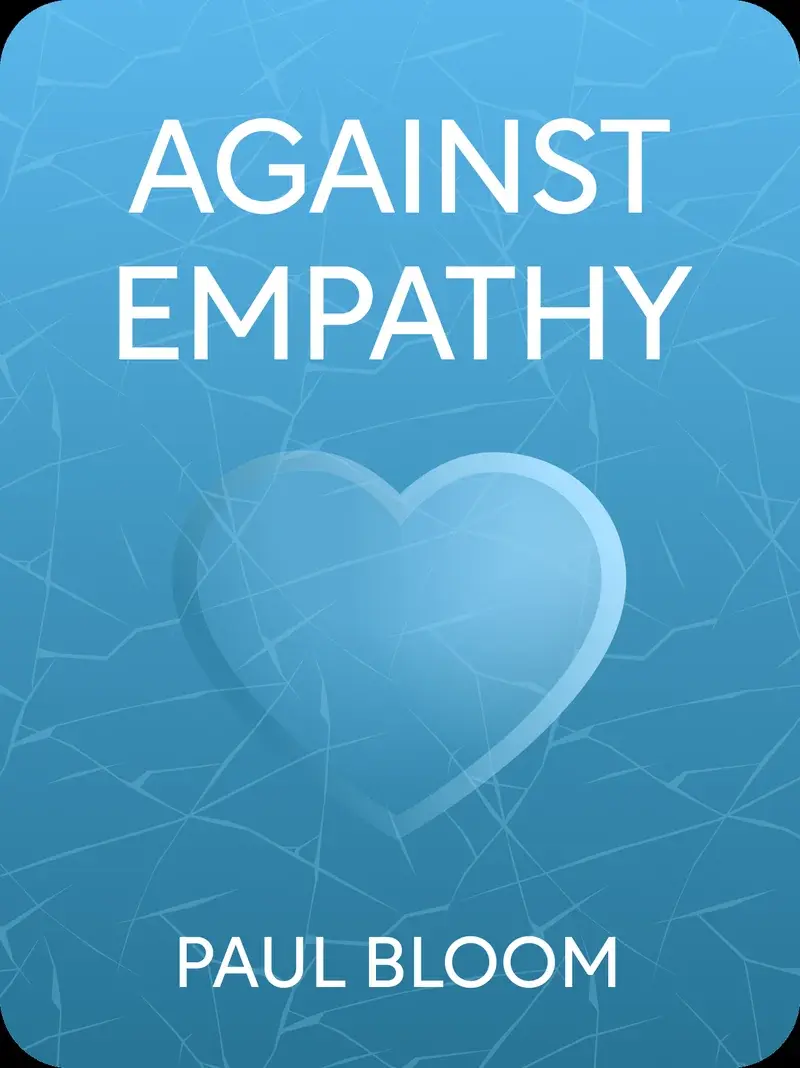
by Paul Bloom
Premium summary · Opens in the app · 5 min read
Against Empathy explains the problems with society’s obsession with empathy and explores its limitations while giving us useful alternatives for situations in which it doesn’t work.
Against Empathy explains the problems with society’s obsession with empathy and explores its limitations while giving us useful alternatives for situations in which it doesn’t work.
Putting ourselves in the shoes of someone else doesn’t seem all that bad. The problem is, we can’t put ourselves into the shoes of everyone, making it biased.
When the tragic shooting at Sandy Hook Elementary took place, it deeply affected many people. Especially those who have children or have had children. So many people expressed outrage and poured out love and support. It got to the point where the state had to actually ask for people to stop giving because it became too much. However, there have been many awful mass shootings since, though none have received the same level of support or outrage.
Sadly, we tend to show even less concern for people in different nations than our own. Though Syrian parents also lost even more children in acts of horrendous violence during the war, there was not nearly the same support from the world as there was with the Sandy Hook victims. This is because it’s easier to relate and feel for people more like us.
Sometimes our concern for other people comes dependent on our perception of whether someone deserves it. In a study, researchers had people watch a video of AIDS patients struggling to cope with pain. Participants were told some had contracted the illness from a transfusion, while the others got it from drug use. The viewers were much less empathetic to those who they were told contracted AIDS from drug use. Unfortunately, it’s clear we are selective with who we feel with.
Sometimes, empathy can drive us to fix problems in the short term, which ends up bad for the long term. Think of a child crying desperately in the store for a sucker. Sometimes, the parent’s empathy kicks in, and they may buy the sucker. Sure, this helps the short term goal of calming the child down. But how about that long term goal of raising a kid without spoiling them rotten? Not so much. People can also abuse empathy. This is true in some Cambodian orphanages, where the people running it take advantage of foreign donors and pocket the money. In some cases, they even have bribed parents to abandon their children to open up more orphanages, and those children are subject to the terrible conditions of these ‘orphanages’. People donate, thinking they are helping, but it is making the problem worse. It also can be dangerous when we feel such strong feelings of empathy for a minority that we make a bad decision for the majority. An example of this is when a girl…
Continue reading in the MinuteRead app
Get the complete 5-minute summary of Against Empathy
Get the complete summary in the appOur empathy is selective and biased, and we don’t realize it.
Empathy can lead us to make bad decisions.
Try rational compassion instead of empathy.
"Against Empathy" is a strong fit if you want practical ideas around communication skills, culture, philosophy, especially themes like our empathy is selective and biased, and we don’t realize it; empathy can lead us to make bad decisions. The MinuteRead summary distills these concepts into a focused read, whether you're deciding whether to buy the book or applying its lessons at work.
Paul Bloom is the Brooks and Suzanne Ragen Professor of Psychology and Cognitive Science at Yale University. His research explores how children and adults understand the physical and social world, with special focus on morality, religion, fiction, and art. His popular writing has appeared in the New York Times, the New Yorker, the Atlantic Monthly, Slate, Natural History, and many other publications. He has won numerous awards for his research and teaching. He lives in Guilford, Connecticut.
View all summaries by Paul BloomContinue Reading
Access the complete 5-minute summary and thousands more nonfiction books in the MinuteRead app.

Continue reading the complete summary in the MinuteRead app.