 MinuteRead
30 min
Book summary
Premium summary · Opens in the app · 30 min read
There is a famous story about the financier Bernard Baruch. When asked how he had managed to become so successful, he reportedly said that he had made his money by selling too soon. It is a clever answer, but it hides a deeper truth. The people who achieve lasting success in any field are not necessarily the ones who make the most brilliant moves. They are the ones who make the fewest catastrophic mistakes.
**Author:** Peter Bevelin **Estimated Reading Time:** 45 minutes
**What You'll Learn:** - Why avoiding stupidity matters more than pursuing brilliance - How to build a latticework of mental models for better decisions - The role of incentives, psychology, and ethics in long-term success - How to think independently and resist herd behavior - Practical frameworks for investing, business, and life
**Who This Book Is For:** This book is for anyone who wants to make better decisions. It is for investors who are tired of chasing hot tips and complex strategies. It is for business leaders who want to build organizations that last. It is for students of human nature who want to understand why smart people do foolish things. Most of all, it is for people who suspect that the best answers are often the simplest ones, and that the path to wisdom begins with knowing what to avoid.
There is a famous story about the financier Bernard Baruch. When asked how he had managed to become so successful, he reportedly said that he had made his money by selling too soon. It is a clever answer, but it hides a deeper truth. The people who achieve lasting success in any field are not necessarily the ones who make the most brilliant moves. They are the ones who make the fewest catastrophic mistakes. Peter Bevelin's book is built around a simple question that the investor Charlie Munger likes to ask: "All I want to know is where I'm going to die, so I'll never go there." It is a joke, but it contains a profound insight. If you can identify the behaviors, decisions, and patterns that lead to failure, you can systematically avoid them. You do not need to be a genius. You do not need to predict the future. You just need to avoid the obvious paths to ruin. This idea comes from the world of investing, where Bevelin has spent decades studying the partnership between Warren Buffett and Charlie Munger. These two men built one of the most successful investment records in history, not by using complex financial models or cutting-edge technology, but by applying a handful of simple principles with extraordinary discipline. They avoided businesses they did not understand. They avoided debt they could not repay. They avoided following the crowd into overpriced investments. They avoided making decisions when they were emotional or tired. The problem is that most people do not think this way. We are drawn to complexity. We believe that difficult problems require difficult solutions. We admire people who sound sophisticated and use big words. We assume that if an investment strategy is simple, it cannot be very good. This bias toward complexity is…
Continue reading in the MinuteRead app
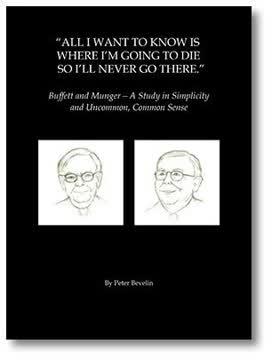
Get the complete 30-minute summary of All I Want To Know Is Where I'm Going To Die So I'll Never Go There
Get the complete summary in the app**Avoid failure rather than pursuing success.** Identify what leads to ruin and systematically avoid it.
**Keep things simple.** Simple principles applied consistently beat complex strategies.
**Learn from mistakes.** Analyze failures objectively and develop systems to prevent repetition.
**Build a latticework of mental models.** Draw on insights from multiple disciplines to understand complex situations.
**Understand incentives.** Show me the incentive and I will show you the outcome.
**Protect your reputation.** It takes decades to build and minutes to destroy.
"All I Want To Know Is Where I'm Going To Die So I'll Never Go There" is a strong fit if you want practical ideas around business, philosophy, finance, especially themes like **avoid failure rather than pursuing success.** identify what leads to ruin and systematically avoid it; **keep things simple.** simple principles applied consistently beat complex strategies. The MinuteRead summary distills these concepts into a focused read, whether you're deciding whether to buy the book or applying its lessons at work.
Peter Bevelin is an author known for his books on wisdom, decision-making, and investing. He has a reputation for meticulously researching and compiling insights from successful individuals, particularly Warren Buffett and Charlie Munger. Bevelin's writing style often involves presenting complex ideas in accessible formats, such as dialogues or curated quotes. His works, including "Seeking Wisdom" and "All I Want to Know Is Where I'm Going to Die So I'll Never Go There," are highly regarded in t…
View all summaries by Peter BevelinContinue Reading
Access the complete 30-minute summary and thousands more nonfiction books in the MinuteRead app.

Continue reading the complete summary in the MinuteRead app.






