MinuteRead
30 min
Book summary
Premium summary · Opens in the app · 30 min read
Most of us walk through life assuming tomorrow will look roughly like today. We make plans based on that assumption. We build careers, launch businesses, raise families, and design institutions all on the quiet belief that the future will be a gentle extension of the present. Then something happens. A technology emerges that no one took seriously. A political shift occurs that seemed impossible. A market collapses. A pandemic arrives. And suddenly, the world looks nothing like the one we prepare
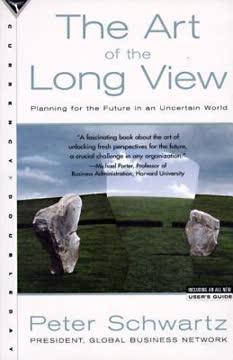
**Author:** Peter Schwartz **Estimated Reading Time:** 45 minutes
**What You'll Learn:** How to think clearly about an unpredictable future, build robust strategies, and develop the mental habits that allow you to see change before it arrives.
**Who This Book Is For:** Leaders, planners, entrepreneurs, and anyone who must make important decisions today whose consequences will unfold over years or decades. If you have ever felt blindsided by events, this book will change how you look at the horizon.
Most of us walk through life assuming tomorrow will look roughly like today. We make plans based on that assumption. We build careers, launch businesses, raise families, and design institutions all on the quiet belief that the future will be a gentle extension of the present. Then something happens. A technology emerges that no one took seriously. A political shift occurs that seemed impossible. A market collapses. A pandemic arrives. And suddenly, the world looks nothing like the one we prepared for. The problem is not that we fail to predict the future. The problem is that we try to predict it at all. Peter Schwartz learned this lesson early in his career. As a young man, he worked at the Stanford Research Institute, where he encountered a group of thinkers who were developing a radically different approach to thinking about tomorrow. Later, at Royal Dutch Shell, he helped pioneer a method that would become legendary in the business world. Shell used scenarios to anticipate the oil shocks of the 1970s, and while competitors reeled, Shell navigated the turbulence with remarkable agility. The company did not predict the future. It prepared for several possible futures, and when one of them arrived, it was ready. This book is about that method. It is about learning to think in stories about the future, stories that are not predictions but rehearsals. Scenarios are tools for expanding your perception, for seeing the forces that are already shaping tomorrow, and for making decisions that hold up across a range of possible worlds. The challenge is that most of us are trapped by our own mental models. We filter out information that contradicts what we expect. We dismiss signals that seem too strange or too threatening. We cling to the familiar because the unfamiliar feels dangerous. But the future does not care about our comfort. It unfolds according to forces that are already in motion, and those who can perceive those forces early have a profound advantage. Schwartz offers a way out of this trap. He teaches us how to identify the driving forces that shape events, how to distinguish what is predetermined from what is genuinely uncertain, how to weave these elements into compelling narratives, and how…
Continue reading in the MinuteRead app
Get the complete 30-minute summary of Art of the Long View, The
Get the complete summary in the appScenarios are stories about possible futures, not predictions of what will happen.
The official future is only one of many possibilities. Do not mistake it for certainty.
Identify driving forces: the social, technological, economic, environmental, and political factors shaping the future.
Distinguish predetermined elements from critical uncertainties. Build scenarios around the uncertainties.
Craft scenario narratives that are vivid, plausible, and internally consistent.
Test your strategies against multiple scenarios. Look for strategies that work across all of them.
"Art of the Long View, The" is a strong fit if you want practical ideas around business, management, leadership, especially themes like scenarios are stories about possible futures, not predictions of what will happen; the official future is only one of many possibilities. do not mistake it for certainty. The MinuteRead summary distills these concepts into a focused read, whether you're deciding whether to buy the book or applying its lessons at work.
Peter Schwartz is a renowned futurist and author of several books on scenario planning and future trends. He co-founded the strategy firm Global Business Network and worked as a scenario planner for Royal Dutch Shell. Schwartz's expertise extends to consulting for films like "Minority Report" and "War Games." His book "The Art of the Long View" is widely regarded as a foundational text in scenario planning. Schwartz holds a B.S. in aeronautical engineering and astronautics from Rensselaer Polyte…
View all summaries by Peter SchwartzContinue Reading
Access the complete 30-minute summary and thousands more nonfiction books in the MinuteRead app.

Continue reading the complete summary in the MinuteRead app.