 MinuteRead
30 min
Book summary
Premium summary · Opens in the app · 30 min read
Every day you negotiate. You negotiate with your employer over salary and responsibilities. You negotiate with your spouse over household decisions. You negotiate with colleagues over project timelines and resource allocation. You negotiate with vendors, clients, and partners. Some of these negotiations are formal and high-stakes. Others are casual and barely noticeable. But all of them shape the quality of your life, your career, and your relationships.
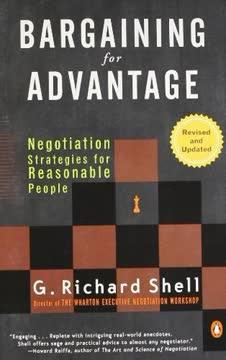
**Author:** G. Richard Shell **Estimated Reading Time:** 45 minutes
How to negotiate effectively by understanding your natural style, setting ambitious goals, leveraging relationships and standards, and following a proven four-step process that works across cultures and contexts.
Professionals who negotiate salaries, contracts, and deals. Entrepreneurs building partnerships. Anyone who wants to advocate for themselves more effectively while maintaining integrity and building lasting relationships.
Every day you negotiate. You negotiate with your employer over salary and responsibilities. You negotiate with your spouse over household decisions. You negotiate with colleagues over project timelines and resource allocation. You negotiate with vendors, clients, and partners. Some of these negotiations are formal and high-stakes. Others are casual and barely noticeable. But all of them shape the quality of your life, your career, and your relationships. Yet most people approach negotiation with a mix of anxiety and guesswork. They worry about being taken advantage of. They fear damaging relationships by pushing too hard. They wonder if they left money on the table or conceded too quickly. They walk away from negotiations feeling either triumphant or defeated, but rarely fully satisfied. The problem is not that people lack intelligence or motivation. The problem is that they have never learned a systematic way to think about negotiation. They rely on folk wisdom, personality instincts, and trial and error. They assume that good negotiators are born, not made. They believe that negotiation is a contest of wills where the toughest person wins. G. Richard Shell spent decades studying negotiation at the Wharton School of Business, working with executives, diplomats, lawyers, and entrepreneurs. His research revealed something surprising. The best negotiators are not the most aggressive or the most manipulative. They are the most prepared, the most self-aware, and the most adaptable. They understand that negotiation is not a battle to be won but a process to be managed. The central insight of this book is both simple and profound: to be good at negotiation, you must learn to be yourself at the bargaining table. This does not mean being passive or accepting whatever comes your way. It means understanding your natural tendencies, leveraging your strengths, managing your weaknesses, and adapting your approach to the situation at hand. Shell's approach is built on a foundation of research from psychology, economics, and behavioral science. He draws on studies of how people actually behave in negotiations, not how they should behave in theory. He examines the role of emotions, relationships, ethics, and cultural differences. He provides practical tools that work in the real world, where negotiations are messy, unpredictable, and deeply human. What makes this book different from other negotiation guides is its emphasis on authenticity. Shell does not ask you to…
Continue reading in the MinuteRead app
Get the complete 30-minute summary of Bargaining for Advantage
Get the complete summary in the appKnow your negotiation style and adapt to the situation.
Set specific, ambitious goals before every negotiation.
Use authoritative standards to strengthen your position.
Invest in relationships before you need them.
Uncover the other party's underlying interests.
Build leverage by developing alternatives and creating competition.
"Bargaining for Advantage" is a strong fit if you want practical ideas around business, communication, psychology, especially themes like know your negotiation style and adapt to the situation; set specific, ambitious goals before every negotiation. The MinuteRead summary distills these concepts into a focused read, whether you're deciding whether to buy the book or applying its lessons at work.
G. Richard Shell is a professor at the Wharton School of Business, specializing in legal studies, business ethics, and management. He has authored several successful books on negotiation, success, and ethics, including "Bargaining for Advantage" and "The Conscience Code." Shell directs executive workshops on negotiation and persuasion at Wharton, teaching a diverse range of professionals from CEOs to teachers. His books have sold over 500,000 copies and been translated into multiple languages. S…
View all summaries by G. Richard ShellContinue Reading
Access the complete 30-minute summary and thousands more nonfiction books in the MinuteRead app.

Continue reading the complete summary in the MinuteRead app.






