MinuteRead
5 min
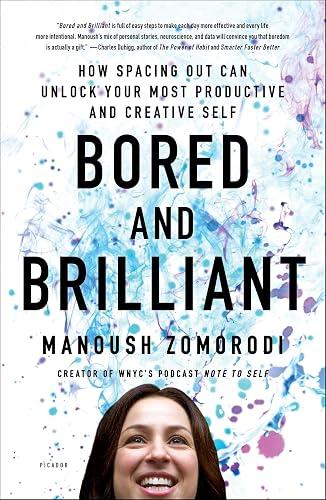
Bored and Brilliant explores the idea of how just doing nothing, daydreaming and spacing out can improve our cognitive functions, enhance creativity and original thinking overall while also helping us relieve stress.
Bored and Brilliant explores the idea of how just doing nothing, daydreaming and spacing out can improve our cognitive functions, enhance creativity and original thinking overall while also helping us relieve stress.
If you’re one of those people who associates boredom with laziness, you’ll have to think again! According to the science behind psychology and neurology, boredom fosters creativity. Just look at the masterminds of some of the world, such as Steve Jobs, the founder of Apple, or J. R. R. Tolkien, the writer of The Hobbit.
Both came up with their brilliant ideas through boredom. Letting their mind do nothing and get creative led them to incredible disruptions. Indeed, boredom and white space leave room for your brain to rest, reset, and start wandering around, when it does that, great ideas emerge and brainstorming occurs.
Not only is it a natural process, but it also engances cognitive functions. Boredom is a part of our evolution as humans too. It allowed us to think about more than just survival and come up with great creations. Therefore, instead of taming boredom by trying to be efficient, it’s best to just let yourself go through it.
Being bored doesn’t always imply that your mind will come up with some ingenious ideas about the world and how to change it. Nor will it help you relieve stress and feel more productive after. Mind-wandering can happen in three ways, yet only one of those can actually help you achieve better mind outputs.
Here are the three types of daydreaming:
Poor attention control Guilty-dysphoric Positive-constructive
You’ve probably guessed by now – the last one is the type of mind wandering you’ll want to practice. Poor attention control refers to that time when you just can’t focus on anything. That implies great ideas or a narrative of any kind.
Then, there’s the guilty-dysphoric type, which happens when your mind wander into a negative space. Here yoru critique is self-destructive, you delve into pessimistic thoughts, and end up diminishing your joy and increasing stress. Obviously, you don’t want that either.
Therefore, it’s best to practice positive-consgtructive daydreaming when you’re bored. Think about where you are in life, what you want to do, what you’d like to create, or find constructive thoughts to run on the back of your mind. This default mode is healthy both for your brain and for your emotional side.
The author stresses the importance of embracing boredom as it is: a non-complex state of mind where your brain does literally nothing..until it does! In that moment, you’ll drift it towards positive-constructive daydreaming, and voila – great ideas emerge. Now, to embrace boredom implies banning distractions from your life. The author took its readers…
Continue reading in the MinuteRead app
Get the complete 5-minute summary of Bored and Brilliant
Get the complete summary in the appBeing bored leaves room for your brain to rest, innovate, and come up with new ideas
There are three types of daydreaming, among which only one is productive
Quitting our phone addiction andembracing boredom will help you uncover the genius within
"Bored and Brilliant" is a strong fit if you want practical ideas around career, management, mental health, especially themes like being bored leaves room for your brain to rest, innovate, and come up with new ideas; there are three types of daydreaming, among which only one is productive. The MinuteRead summary distills these concepts into a focused read, whether you're deciding whether to buy the book or applying its lessons at work.
Manoush Zomorodi (muh-NOOSH Zoh-moe-road-ee) is an award-winning journalist, bestselling author, and host of NPR's TED Radio Hour, where she explores fascinating ideas with the world's greatest thinkers. Her "Body Electric" project, a groundbreaking collaboration between NPR and Columbia University Medical Center involving over 20,000 participants, represents one of the largest public health studies of its kind. With her "Body Electric" book (Flatiron, May 2026), she delivers her most important…
View all summaries by Manoush ZomorodiContinue Reading
Access the complete 5-minute summary and thousands more nonfiction books in the MinuteRead app.

Continue reading the complete summary in the MinuteRead app.