MinuteRead
30 min
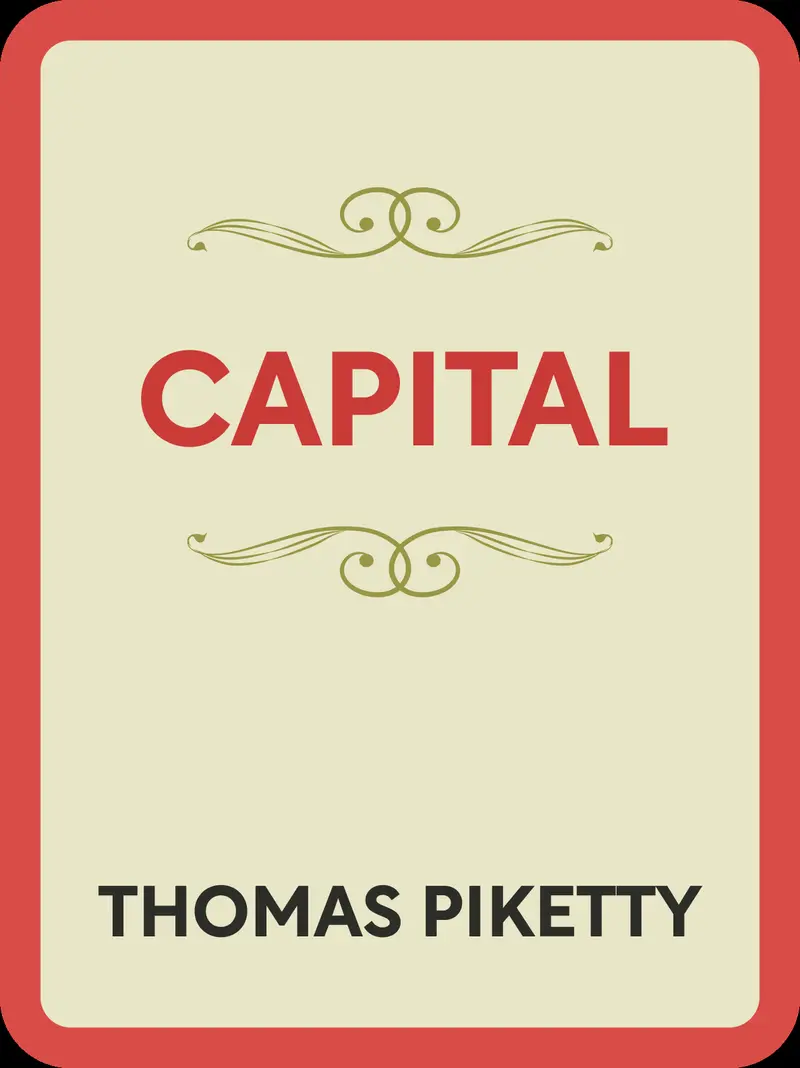
Book summary
Premium summary · Opens in the app · 30 min read
For most of the twentieth century, a comfortable assumption governed economic thinking. The assumption was that capitalism, left to its own devices, would gradually distribute its fruits more widely. The horrors of the Gilded Age, with its robber barons and inherited fortunes, were supposed to fade into history. Growth, technology, and education would lift all boats. Inequality would decline naturally as economies matured. This was the promise of the Kuznets curve, named after economist Simon Ku
**Author:** Thomas Piketty
**Estimated Reading Time:** 45 minutes
**What You'll Learn:**
- Why wealth inequality is not an accident of markets but a product of political choices - The central formula r > g and why it explains the return of patrimonial capitalism - How the twentieth century's reduction in inequality was an exception, not a rule - Why inherited wealth is reasserting its dominance over earned wealth - What policy tools, especially progressive taxation, can address these forces - How capital transformed from farmland to finance without losing its power
**Who This Book Is For:**
This book is for anyone who senses that something fundamental has shifted in modern economies. It is for readers who wonder why hard work no longer seems to guarantee security, why housing prices outpace wages, why inheritance looms larger than entrepreneurship, and why the wealthy seem to operate by different rules. It is for those who want to understand the deep historical forces shaping inequality, not through slogans or ideology, but through data, history, and rigorous analysis. If you have ever asked whether the economy is rigged, whether meritocracy is real, or whether democracy can survive extreme wealth concentration, this book provides the intellectual foundation for answering those questions.
For most of the twentieth century, a comfortable assumption governed economic thinking. The assumption was that capitalism, left to its own devices, would gradually distribute its fruits more widely. The horrors of the Gilded Age, with its robber barons and inherited fortunes, were supposed to fade into history. Growth, technology, and education would lift all boats. Inequality would decline naturally as economies matured. This was the promise of the Kuznets curve, named after economist Simon Kuznets, and it became the unspoken consensus of the postwar era. Thomas Piketty's Capital in the Twenty-First Century dismantles that assumption with extraordinary care. The book's central claim is that the reduction of inequality in the mid-twentieth century was not the natural outcome of capitalism. It was the product of war, depression, and deliberate political interventions. The shocks of two world wars destroyed capital, inflation eroded its value, and governments imposed taxes and regulations that had been unimaginable before 1914. The result was a historically unusual period of relative equality, roughly from 1945 to 1980. That period is now over. Since the 1980s, the forces that once concentrated wealth have reasserted themselves. The return on capital has outpaced economic growth, inherited wealth has regained its dominance, and the gap between the very rich and everyone else has widened dramatically. Piketty argues that this is not a temporary aberration. It is the default condition of capitalism when growth is slow and capital is free to accumulate. The book is built on…
Continue reading in the MinuteRead app
Get the complete 30-minute summary of Capital in the Twenty First Century
Get the complete summary in the appWealth distribution is a political artifact, not a natural phenomenon.
When r > g, wealth accumulates faster than income grows, leading to concentration.
The twentieth century's reduction in inequality was caused by war, depression, and policy, not by natural economic force
The Kuznets curve was based on fragile evidence, and inequality has risen sharply since the 1970s.
Inherited wealth is reasserting its dominance over earned wealth.
The social state is a political achievement that is now under threat.
"Capital in the Twenty First Century" is a strong fit if you want practical ideas around economics, politics, history, especially themes like wealth distribution is a political artifact, not a natural phenomenon; when r > g, wealth accumulates faster than income grows, leading to concentration. The MinuteRead summary distills these concepts into a focused read, whether you're deciding whether to buy the book or applying its lessons at work.
Thomas Piketty is a French economist known for his work on wealth and income inequality. Born in 1971, he earned his Ph.D. at 22 and has held positions at MIT, CNRS, and EHESS. Piketty is the director of studies at EHESS and professor at the Paris School of Economics, which he helped establish. His best-selling book, Capital in the Twenty-First Century, argues that wealth inequality will increase as capital returns outpace economic growth. Piketty proposes a global wealth tax to address this iss…
View all summaries by Thomas PikettyContinue Reading
Access the complete 30-minute summary and thousands more nonfiction books in the MinuteRead app.

Continue reading the complete summary in the MinuteRead app.