MinuteRead
30 min
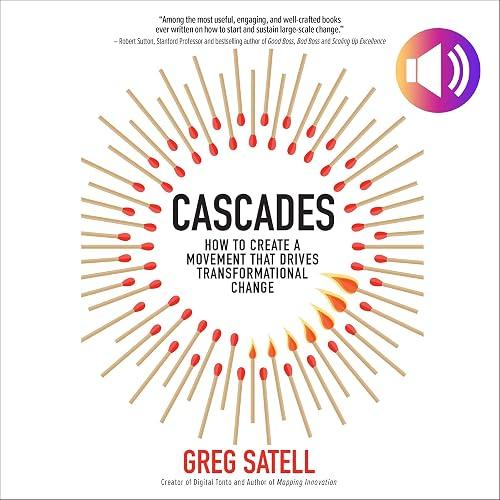
Book summary
by Greg Satell
Premium summary · Opens in the app · 30 min read
Every significant change in history began with a mystery. How did a handful of ordinary people in Serbia topple a dictator who controlled the military, the police, and the media? How did a salt march in India become the crack that brought down an empire? How did a small group of engineers in Silicon Valley create an innovation ecosystem that would dominate the global economy for decades?
**Author:** Greg Satell **Estimated Reading Time:** 45 minutes
How transformational change actually happens, why networks outperform hierarchies, and how to build movements that create lasting impact in organizations, communities, and society.
Leaders who need to drive change without formal authority. Activists building movements. Entrepreneurs challenging established industries. Anyone who has ever tried to make something better and discovered that good ideas alone are not enough.
Every significant change in history began with a mystery. How did a handful of ordinary people in Serbia topple a dictator who controlled the military, the police, and the media? How did a salt march in India become the crack that brought down an empire? How did a small group of engineers in Silicon Valley create an innovation ecosystem that would dominate the global economy for decades? The conventional answers point to charismatic leaders, brilliant strategies, or simply being in the right place at the right time. But these explanations fall apart under scrutiny. Most charismatic leaders fail. Most brilliant strategies never get implemented. And being in the right place at the right time matters far less than what you do once you are there. Greg Satell spent years studying revolutions, corporate turnarounds, social movements, and innovation ecosystems. What he discovered challenges much of what we believe about how change works. The secret is not found in the qualities of exceptional individuals. It is found in the structure of networks and the dynamics of how ideas spread through them. The world has fundamentally shifted. For most of human history, power was concentrated in hierarchies. Kings ruled subjects. CEOs commanded employees. Media outlets broadcast to passive audiences. Change flowed from the top down. But the digital revolution dismantled many of these structures. Power now flows through networks, and networks operate by different rules. This creates a paradox. Hierarchies are dying, but most of us still think in hierarchical terms. We look for the person in charge. We try to identify the influencer. We craft messages designed to persuade key decision-makers. These approaches worked in the old world. In the new world, they consistently fail. Consider the Arab Spring. In 2011, protest movements swept across the Middle East with astonishing speed. Dictators who had ruled for decades fell within weeks. But most of these revolutions failed to create lasting change. Why? Because overthrowing a dictator is different from building a new society. The movements had enough network density to topple regimes but lacked the structure, values, and platforms needed to govern. Compare that to the Otpor movement in Serbia. A small group of students built a network that grew to over 70,000 trained activists. They did not just protest. They built an organization designed to survive victory.…
Continue reading in the MinuteRead app
Get the complete 30-minute summary of Cascades
Get the complete summary in the appCascades, not commands, drive transformational change.
The myth of influentials is wrong. Easily influenced people influencing other easily influenced people creates cascades.
Build networks of small groups, loosely connected, united by a common purpose.
Identify a keystone change: a specific, tangible goal that catalyzes broader transformation.
Map your Spectrum of Allies and focus on moving neutrals and passive supporters.
Develop shared values that guide decentralized decision-making.
"Cascades" is a strong fit if you want practical ideas around leadership, business, management, especially themes like cascades, not commands, drive transformational change; the myth of influentials is wrong. easily influenced people influencing other easily influenced people creates cascades. The MinuteRead summary distills these concepts into a focused read, whether you're deciding whether to buy the book or applying its lessons at work.
Motivated to help readers with "Small groups, Greg Satell wrote “Cascades” to package those ideas for a fast, focused read. In “Cascades”, Greg Satell focuses on "Small groups. Through “Cascades”, Greg Satell distills the core ideas on leadership into lessons readers can absorb in a single short sitting. Readers turn to this work when they want Greg Satell's perspective on the subject without working through the entire original volume. Greg Satell wrote “Cascades” to make the book's central argu…
Continue Reading
Access the complete 30-minute summary and thousands more nonfiction books in the MinuteRead app.

Continue reading the complete summary in the MinuteRead app.