MinuteRead
30 min
Book summary
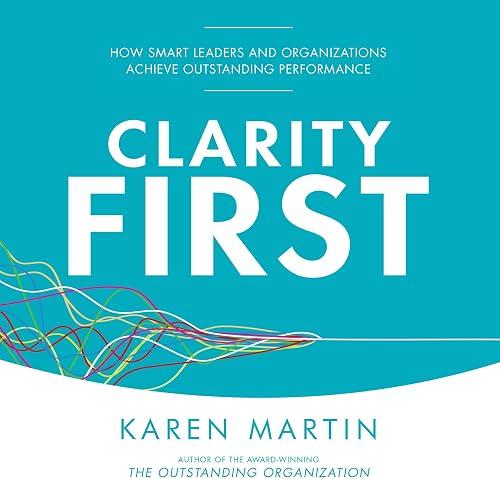
by Karen Martin
Premium summary · Opens in the app · 30 min read
Every organization operates with a certain amount of fog. It settles into mission statements that sound impressive but mean nothing. It hides in job descriptions that describe aspirations rather than actual work. It lives in the gap between what leaders believe they communicated and what employees actually understood. This fog is ambiguity, and it is expensive.
**Author:** Karen Martin **Estimated Reading Time:** 45 minutes
Why ambiguity quietly drains performance from organizations and individuals, how clarity operates as a measurable competitive advantage, and what specific practices create the coherence, precision, and elegance that define high-performing teams.
Leaders who sense their organizations are working harder than necessary to achieve mediocre results. Managers frustrated by misalignment, rework, and meetings that generate more confusion than direction. Individual contributors who want to understand why some workplaces feel energizing while others feel exhausting. Anyone who suspects that the gap between current performance and potential is not a talent problem but a clarity problem.
Every organization operates with a certain amount of fog. It settles into mission statements that sound impressive but mean nothing. It hides in job descriptions that describe aspirations rather than actual work. It lives in the gap between what leaders believe they communicated and what employees actually understood. This fog is ambiguity, and it is expensive. Karen Martin wrote *Clarity First* because she kept encountering the same pattern across industries, geographies, and organizational sizes. Companies with talented people, solid strategies, and adequate resources were underperforming. The problem was not effort. People were working hard. The problem was not intelligence. The people involved were smart. The problem was that nobody could see clearly enough to aim their effort and intelligence in the right direction. Consider what happens when ambiguity reigns. A team launches a project without a clear definition of success. Six months later, they have produced something, but nobody can say whether it is good. A leader announces a new priority, but does not explain what existing work should stop. Employees nod, return to their desks, and continue doing what they were doing before. A customer complaint surfaces, but the root cause is never investigated because the problem is "handled" by appeasing the customer. The underlying defect remains, ready to generate the next complaint. These are not dramatic failures. They are quiet ones. They do not make headlines. They simply accumulate, day after day, into mediocrity. Martin's central observation is that ambiguity feels easier than clarity in the short term. It is easier to say "we need to improve quality" than to define what quality means, how it will be measured, who owns it, and what trade-offs are acceptable. It is easier to let priorities shift with the latest executive whim than to make hard choices about what matters most. It is easier to tolerate a broken process than to map it, understand it, and redesign it. Ambiguity is the path of least resistance. But the short-term ease of ambiguity carries a long-term cost. Economist Nicholas Bloom's research, which Martin cites, demonstrates that organizations with clear targets, incentives, and…
Continue reading in the MinuteRead app
Get the complete 30-minute summary of Clarity First
Get the complete summary in the appClarity is the foundation of outstanding performance, and ambiguity is the root cause of most underperformance.
Clarity is not certainty. It is the ability to act effectively in uncertain conditions.
Clarity exhibits three qualities: coherence, precision, and elegance.
Purpose is the reason an organization exists. It must be specific enough to guide decisions.
Priorities must be few. If you chase two rabbits, you will lose them both.
Processes determine how work gets done. Most processes evolve accidentally rather than being designed deliberately.
"Clarity First" is a strong fit if you want practical ideas around leadership, business, management, especially themes like clarity is the foundation of outstanding performance, and ambiguity is the root cause of most underperformance; clarity is not certainty. it is the ability to act effectively in uncertain conditions. The MinuteRead summary distills these concepts into a focused read, whether you're deciding whether to buy the book or applying its lessons at work.
Motivated to help readers with clarity is an essential but far too often overlooked foundation in the quest for success—both for, Karen Martin wrote “Clarity First” to package those ideas for a fast, focused read. In “Clarity First”, Karen Martin focuses on clarity is an essential but far too often overlooked foundation in the quest for success—both for. Through “Clarity First”, Karen Martin distills the core ideas on leadership into lessons readers can absorb in a single short sitting. Readers …
Continue Reading
Access the complete 30-minute summary and thousands more nonfiction books in the MinuteRead app.

Continue reading the complete summary in the MinuteRead app.