MinuteRead
30 min
Book summary
by Marcia Reynolds
Premium summary · Opens in the app · 30 min read
Most people believe coaching is about asking good questions. They think if you ask the right question, the other person will have a breakthrough. They believe the key to helping someone is finding the perfect sequence of inquiries that unlocks their hidden potential.
**Author:** Marcia Reynolds
**Estimated Reading Time:** 45 minutes
**What You'll Learn**
You will learn why asking questions is not enough to create lasting change. You will discover how to use reflective inquiry to help people see their own thinking, challenge their assumptions, and turn insight into action. You will understand the brain science behind why this approach works and how to create the psychological safety required for transformative conversations.
**Who This Book Is For**
This book is for coaches, leaders, managers, therapists, teachers, and anyone who wants to help others grow. If you have ever felt frustrated when someone did not follow through on a commitment, or when a conversation went in circles without resolution, this book will show you a different path. It is for people who want to move beyond giving advice and start facilitating real change.
Most people believe coaching is about asking good questions. They think if you ask the right question, the other person will have a breakthrough. They believe the key to helping someone is finding the perfect sequence of inquiries that unlocks their hidden potential. This belief is wrong. Questions alone do not create change. In fact, questions can sometimes make things worse. They can feel like an interrogation. They can put people on the defensive. They can lead to intellectual conversations that never touch the real issue. The person being coached answers your questions, but nothing shifts inside them. They leave the conversation with the same beliefs, the same fears, and the same patterns they walked in with. Marcia Reynolds discovered this through decades of coaching executives, leaders, and high performers around the world. She noticed that even when she asked powerful questions, clients often remained stuck. They would nod, agree, and then return to their old behaviors. The problem was not the questions. The problem was the entire premise of coaching as a question-and-answer exchange. Reynolds began to study what actually happens in the brain when people experience genuine insight. She explored the neuroscience of change, the conditions that allow new neural connections to form, and the conversational patterns that either support or block transformation. What she found challenged the conventional wisdom about coaching. The answer was not better questions. The answer was reflective inquiry. Reflective inquiry combines questions with reflective statements. It is a way of engaging that helps people see their own thinking from the outside. Instead of asking someone to explain their reasoning, you reflect back what you heard, what you noticed, and what you sense. Then you ask a question that emerges from genuine curiosity. This small shift changes everything. When you reflect before you ask, you create a pause. In that pause, the other person has…
Continue reading in the MinuteRead app
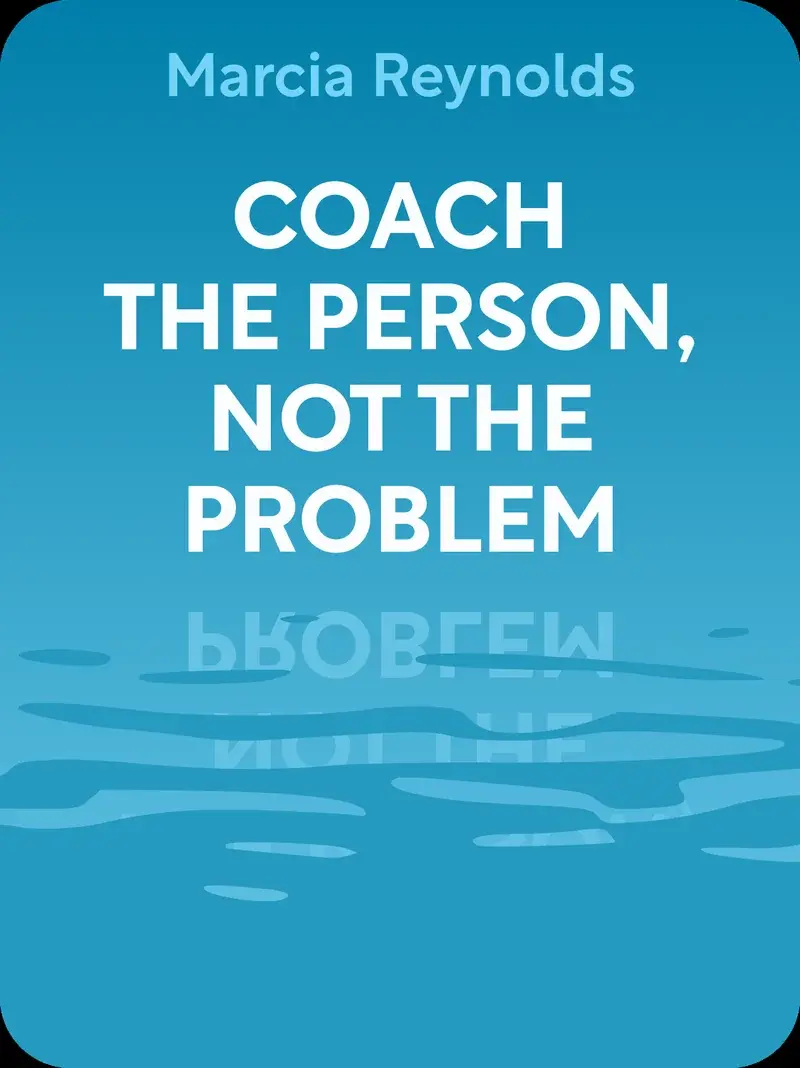
Get the complete 30-minute summary of Coach the Person, Not the Problem
Get the complete summary in the appReflect before you ask. Reflective statements create the pause that allows insight to emerge.
Coach the person, not the problem. Focus on expanding self-awareness, not just solving the immediate issue.
Use active replay to help clients see their own thinking objectively.
Explore the internal framework: stories, beliefs, needs, and values.
Use goaltending to keep conversations focused while remaining flexible.
Turn insights into commitments with specific actions, timelines, and accountability.
"Coach the Person, Not the Problem" is a strong fit if you want practical ideas around leadership, business, psychology, especially themes like reflect before you ask. reflective statements create the pause that allows insight to emerge; coach the person, not the problem. focus on expanding self-awareness, not just solving the immediate issue. The MinuteRead summary distills these concepts into a focused read, whether you're deciding whether to buy the book or applying its lessons at work.
Motivated to help readers with coaching should be a process of inquiry, Marcia Reynolds wrote “Coach the Person, Not the Problem” to package those ideas for a fast, focused read. In “Coach the Person, Not the Problem”, Marcia Reynolds focuses on coaching should be a process of inquiry. Through “Coach the Person, Not the Problem”, Marcia Reynolds distills the core ideas on leadership into lessons readers can absorb in a single short sitting. Readers turn to this work when they want Marcia Reynold…
Continue Reading
Access the complete 30-minute summary and thousands more nonfiction books in the MinuteRead app.

Continue reading the complete summary in the MinuteRead app.