MinuteRead
30 min
Book summary
Premium summary · Opens in the app · 30 min read
In the early 2000s, a remarkable shift began taking place across the business landscape. Companies that had once competed on product quality, operational efficiency, or brand strength started discovering something unexpected: the ability to analyze data was becoming more valuable than any of those traditional advantages.
**Author:** Thomas H. Davenport
**Estimated Reading Time:** 48 minutes
**What You'll Learn:**
- Why analytics has become the defining competitive advantage of modern business - How leading companies transform raw data into strategic decisions - The five stages of analytical maturity and where your organization stands - Practical frameworks for building analytical capability in any industry - How to overcome the cultural, technical, and organizational barriers to data-driven decision making
**Who This Book Is For:**
This book is for leaders who sense that intuition alone is no longer enough. It is for managers who suspect their organizations are sitting on mountains of untapped data while competitors move faster and smarter. It is for analysts who want to understand how their work connects to strategy. And it is for anyone who has ever wondered why some companies seem to know what customers want before the customers themselves do.
In the early 2000s, a remarkable shift began taking place across the business landscape. Companies that had once competed on product quality, operational efficiency, or brand strength started discovering something unexpected: the ability to analyze data was becoming more valuable than any of those traditional advantages. Thomas Davenport watched this transformation unfold from a unique vantage point. As a professor of information technology and management at Babson College, he had spent years studying how organizations use information. What he observed in the early 2000s was not just a technological trend. It was a fundamental change in how winning companies operated. The signs were everywhere. A casino company in Las Vegas was using customer data to predict which gamblers would become loyal patrons and which would drift away. A credit card issuer was running thousands of experiments every year to determine which offers resonated with which customers. A shipping company was optimizing delivery routes with such precision that it saved millions of gallons of fuel annually. A retailer was analyzing point-of-sale data to predict demand for products weeks before customers walked through the door. These companies shared something profound. They had stopped making decisions based primarily on intuition, experience, or hierarchy. Instead, they had built sophisticated systems for collecting data, analyzing it with rigorous statistical methods, and embedding the resulting insights directly into their daily operations. The problem, Davenport realized, was that most companies had no idea how to do this. They had data, certainly. Every company had data. But data alone was worthless. The difference between analytical competitors and everyone else was not the amount of data they possessed. It was what they did with it. Traditional companies used data to look backward. They generated reports showing what happened last quarter, last month, last week. These reports told them where they had been,…
Continue reading in the MinuteRead app
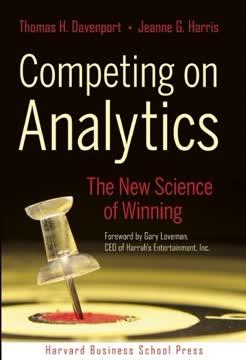
Get the complete 30-minute summary of Competing on Analytics
Get the complete summary in the appAnalytics can support almost any business process, and companies that act on this insight will outperform those that do
Analytical competitors make analytics central to their strategy, not peripheral to their operations.
The five stages of analytical maturity range from analytically impaired to analytical competitor, and most organizations
The analytical architecture includes data warehouses, analytical tools, governance structures, and quality processes, an
People are the scarce ingredient in analytical competition. Technology is necessary but not sufficient.
Customer-centric analytics is the most visible application of analytical competition, and the integration of marketing a
"Competing on Analytics" is a strong fit if you want practical ideas around business, management, science, especially themes like analytics can support almost any business process, and companies that act on this insight will outperform those that do; analytical competitors make analytics central to their strategy, not peripheral to their operations. The MinuteRead summary distills these concepts into a focused read, whether you're deciding whether to buy the book or applying its lessons at work.
Thomas H. Davenport is a prominent figure in business management and information technology. He holds the President's Chair in Information Technology and Management at Babson College and has authored numerous influential books and articles on topics such as business process reengineering, knowledge management, and analytical competition. Thomas H. Davenport 's work has been published in various prestigious journals and he has led research centers at major consulting firms. With a background in s…
View all summaries by Thomas H. DavenportContinue Reading
Access the complete 30-minute summary and thousands more nonfiction books in the MinuteRead app.

Continue reading the complete summary in the MinuteRead app.