 MinuteRead
30 min
Book summary
Premium summary · Opens in the app · 30 min read
Strategy has become a bloated word. It gets attached to nearly every business decision, from choosing office furniture to entering new markets. Consulting firms sell elaborate strategic frameworks. Business schools teach complex analytical tools. Executives speak of strategic vision, strategic alignment, strategic initiatives, and strategic partnerships. Yet for all this activity, most strategic planning produces little of value.
### A Radical Approach to Business Strategy
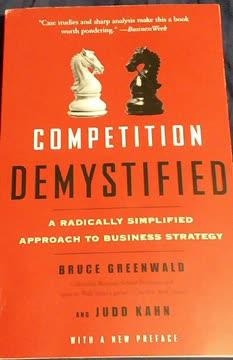
**Author:** Bruce C. Greenwald **Estimated Reading Time:** 45 minutes
**What You'll Learn:** - Why most strategic planning focuses on the wrong things - How to identify real competitive advantages versus imagined ones - The three sources of genuine barriers to entry - How to think about competition, cooperation, and market dynamics - A practical framework for making better strategic decisions
**Who This Book Is For:** Business leaders tired of vague strategy frameworks, investors seeking to understand what makes companies durably profitable, entrepreneurs evaluating market opportunities, and anyone who wants to cut through the noise of conventional business thinking.
Strategy has become a bloated word. It gets attached to nearly every business decision, from choosing office furniture to entering new markets. Consulting firms sell elaborate strategic frameworks. Business schools teach complex analytical tools. Executives speak of strategic vision, strategic alignment, strategic initiatives, and strategic partnerships. Yet for all this activity, most strategic planning produces little of value. Bruce Greenwald, a professor at Columbia Business School and one of the most respected thinkers in value investing, argues that this confusion exists because most strategy work ignores a fundamental question: Does the company actually have a competitive advantage? Without a competitive advantage, strategy barely matters. A company operating in a market without barriers to entry faces a brutal reality. Any profits it earns will attract competitors. Those competitors will drive prices down until returns fall to the minimum level required to keep capital invested. In such markets, the only path to superior performance is operational efficiency. Strategy, in the traditional sense, is largely irrelevant. With a competitive advantage, everything changes. A company protected by barriers to entry can earn above-average returns year after year. It can make strategic choices that shape its industry rather than merely responding to market forces. It can invest for the long term, build customer relationships, and develop capabilities that competitors cannot easily replicate. The problem is that most companies believe they have competitive advantages when they do not. They point to their brand, their technology, their talented people, their customer relationships. But competitive advantages are specific and rare. They arise from only a handful of sources. And they can be identified through clear, observable evidence. Greenwald's approach strips away the mystique surrounding strategy. He offers a simple, rigorous framework for understanding competitive dynamics. The core insight is deceptively simple: If barriers to entry exist, strategy matters enormously. If barriers do not exist, efficiency is everything. This distinction transforms how companies should think about their choices. It explains why some industries produce consistently profitable leaders while others churn through competitors without anyone earning exceptional returns. It clarifies why growth is often the…
Continue reading in the MinuteRead app
Get the complete 30-minute summary of Competition Demystified
Get the complete summary in the appCompetitive advantages are barriers to entry that protect companies from competition.
Without barriers to entry, operational efficiency is the only path to superior performance.
Competitive advantages come from three sources: supply advantages, demand advantages, and economies of scale.
Market share stability and sustained profitability above the cost of capital indicate competitive advantages.
Local dominance creates stronger competitive positions than broad presence.
Growth often destroys competitive advantage by diluting focus and spreading resources too thin.
"Competition Demystified" is a strong fit if you want practical ideas around business, finance, business strategy, especially themes like competitive advantages are barriers to entry that protect companies from competition; without barriers to entry, operational efficiency is the only path to superior performance. The MinuteRead summary distills these concepts into a focused read, whether you're deciding whether to buy the book or applying its lessons at work.
Bruce C. Greenwald is a renowned figure in value investing and corporate strategy. As a professor at Columbia Business School, he teaches the "Economics of Strategic Behavior" MBA class. Bruce C. Greenwald is highly respected for his expertise in value investing and is known as the "guru of Wall Street's gurus." He serves as Head of Research at FirstEagle Funds, which has an impressive track record in long-term value investing. Greenwald's work combines academic rigor with practical business ins…
View all summaries by Bruce C. GreenwaldContinue Reading
Access the complete 30-minute summary and thousands more nonfiction books in the MinuteRead app.

Continue reading the complete summary in the MinuteRead app.






