MinuteRead
30 min
Book summary
by Emily Oster
Premium summary · Opens in the app · 5 min read
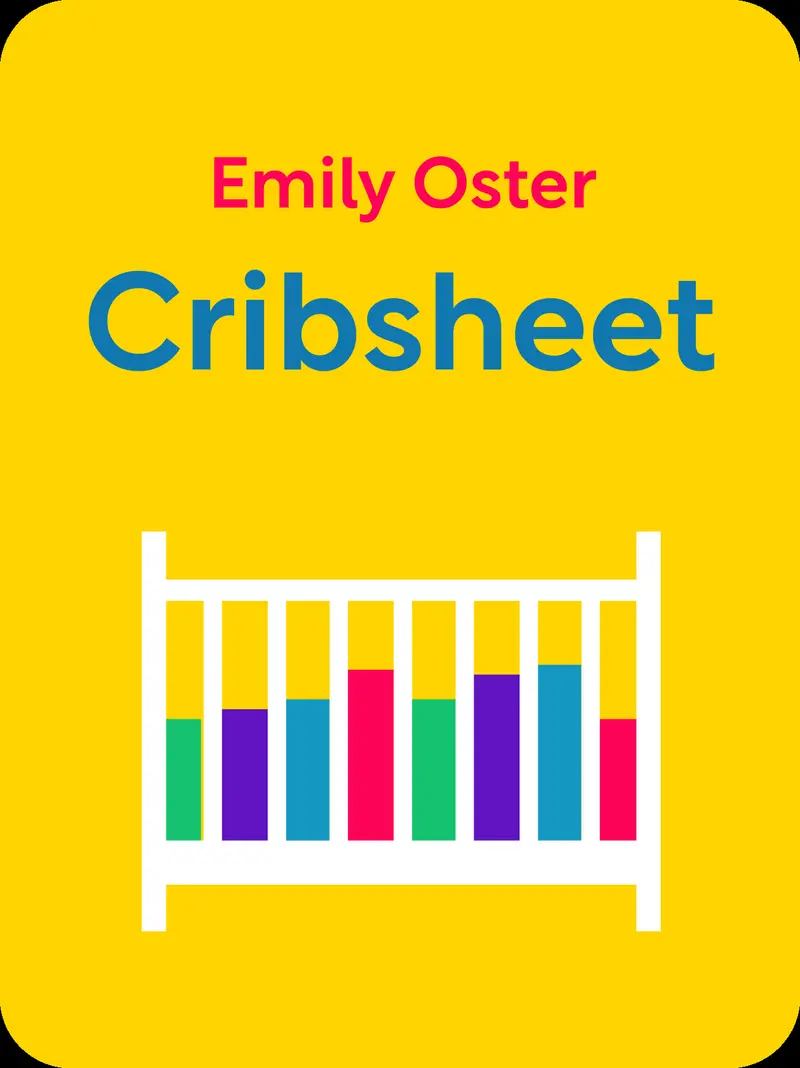
Cribsheet is a smart guide on how to make the best parenting choices for you and your child, by using an economic perspective and evidence-based advice based on scientific data.
Cribsheet is a smart guide on how to make the best parenting choices for you and your child, by using an economic perspective and evidence-based advice based on scientific data.
Right from the moment your bundle of joy arrives you’ll have a lot of choices to make. And people are going to give you a lot of different, and often conflicting advice, whether you ask for it or not. But the problem is that there is no one right answer for everyone. This is where economics comes in.
Economists have to solve a lot of difficult problems. Economics won’t give the same solution for every problem because it takes individual factors into account. Like an economist, you can use a cost-benefit analysis when making decisions.
An example of this would be if you were a working mom deciding between putting your child into a daycare or hiring a nanny. To weigh a decision like this, an economist would look at the benefits and the costs of the choices, which are called “inputs.”
A nanny will typically be more expensive, making daycare to likely the better financial choice. But this will be different based on your financial circumstances. If you don’t have tons of disposable income, the price difference will matter, whereas if your rich, this difference will be trivial.
There are non-monetary inputs too, such as giving up the personalized care of a nanny. Or maybe the social aspect of daycare is important to you— this would be the cost of hiring a nanny. So depending on what your inputs are, you can and should arrive at different decisions than other people.
Economic reasoning involves looking at trade-offs. These trade-offs depend on two principles called opportunity cost and marginal value. If you are trying to decide to stay at home with your child or go back to work, you need to decide whether or not to pay for childcare. If your salary is low and/or the cost of childcare is high in your area, you could lose money. Or maybe the difference in your salary minus childcare isn’t very much. If you love your job or prefer independence, it could make sense to go back to work anyway. But if you don’t need that extra money and want the time with your child, the opportunity cost of losing that time with your child is higher than the marginal value of the money you will receive for going back to work. Another strategy to use is using a risk assessment. This can be helpful for non-monetary choices. Many people don’t consider co-sleeping because studies suggest it is linked to a higher risk of sudden infant death syndrome, or SIDS. The risk…
Continue reading in the MinuteRead app
Get the complete 5-minute summary of Cribsheet
Get the complete summary in the appThe choices you should make as a parent are personal.
Using economic reasoning, you can build a framework that will help you make parenting choices.
You can use scientific studies to guide your decisions, but look for the right ones.
"Cribsheet" is a strong fit if you want practical ideas around parenting, childrens, productivity, especially themes like the choices you should make as a parent are personal; using economic reasoning, you can build a framework that will help you make parenting choices. The MinuteRead summary distills these concepts into a focused read, whether you're deciding whether to buy the book or applying its lessons at work.
Emily Oster is on a mission to empower parents by providing the data and tools they need to make confident decisions. In addition to being a Professor of Economics at Brown University, Emily is the founder and CEO of ParentData, a data-driven guide to pregnancy, parenting, and beyond. ParentData’s weekly newsletter now has hundreds of thousands of subscribers, along with a strong social media community. Emily is also a New York Times best-selling author, whose books include Expecting Better, Cri…
View all summaries by Emily OsterContinue Reading
Access the complete 5-minute summary and thousands more nonfiction books in the MinuteRead app.

Continue reading the complete summary in the MinuteRead app.