MinuteRead
30 min
Book summary
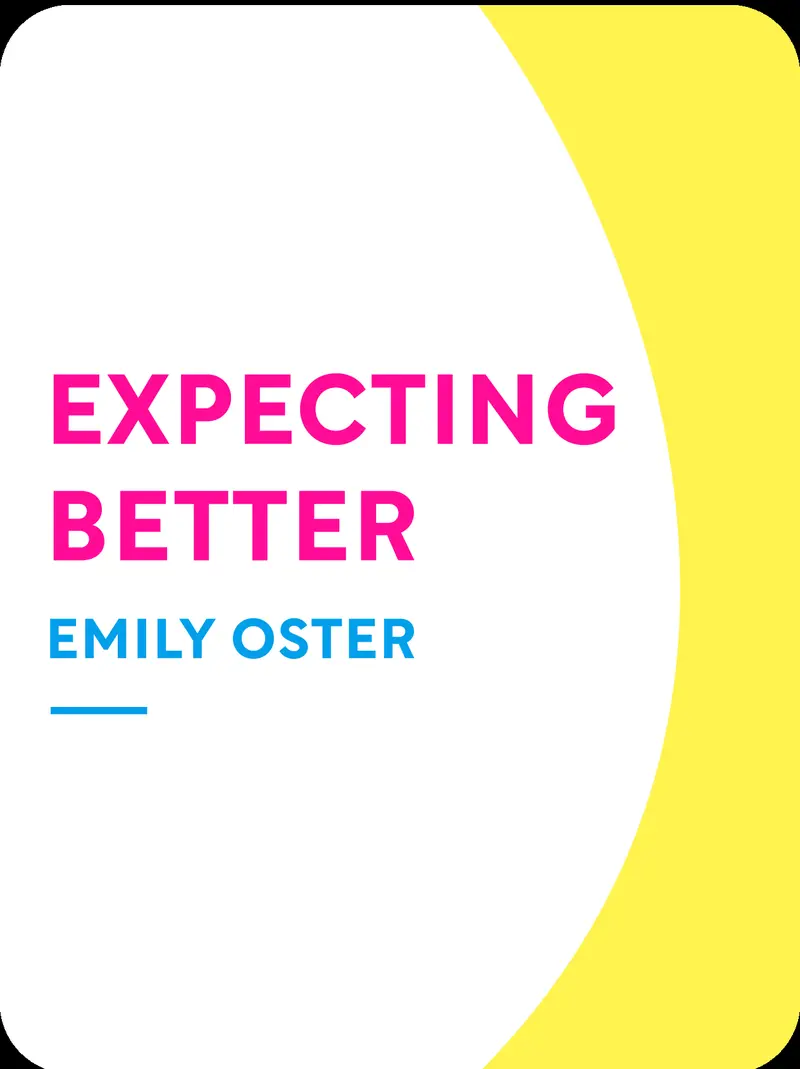
by Emily Oster
Premium summary · Opens in the app · 30 min read
Pregnancy is supposed to be a time of joy and anticipation. Instead, for many women, it becomes a minefield of restrictions, warnings, and guilt. You cannot drink coffee. You cannot eat deli meat. You cannot sleep on your back. You cannot take hot baths. You cannot garden without gloves. You cannot clean the cat's litter box. Every day brings a new prohibition, a new worry, a new reason to feel that you are already failing your unborn child.
**Author:** Emily Oster **Estimated Reading Time:** 45 minutes
The truth about alcohol, caffeine, sushi, prenatal testing, weight gain, exercise, and dozens of other pregnancy decisions, based on what the evidence actually shows rather than what conventional wisdom dictates. You'll learn how to evaluate pregnancy advice through the lens of data and personal values, and how to make choices that work for your life without unnecessary fear or guilt.
Anyone who is pregnant, planning to become pregnant, or supporting someone through pregnancy. This book is especially valuable for readers who want to understand the reasoning behind pregnancy recommendations, who feel overwhelmed by conflicting advice, or who suspect that many pregnancy "rules" are based more on cultural anxiety than solid evidence.
Pregnancy is supposed to be a time of joy and anticipation. Instead, for many women, it becomes a minefield of restrictions, warnings, and guilt. You cannot drink coffee. You cannot eat deli meat. You cannot sleep on your back. You cannot take hot baths. You cannot garden without gloves. You cannot clean the cat's litter box. Every day brings a new prohibition, a new worry, a new reason to feel that you are already failing your unborn child. The problem is not that these rules exist. The problem is that most of them are presented without context, without nuance, and without evidence. When you ask why you cannot eat soft cheese, you are told that it is "better to be safe." When you wonder whether a glass of wine at your anniversary dinner is truly dangerous, you are met with horrified looks rather than data. The underlying message is clear: pregnant women cannot be trusted to make their own decisions, so they must be given blanket rules that err on the side of extreme caution. Emily Oster, an economist at Brown University, found herself confronting this reality when she became pregnant with her first child. As someone who spent her career analyzing data and evaluating evidence, she assumed she could simply look up the research on pregnancy recommendations and make informed choices. What she discovered shocked her. Many of the most common pregnancy rules were based on weak evidence, outdated studies, or no evidence at all. Some recommendations contradicted the available data. Others were so overly cautious that they treated pregnant women as incapable of weighing risks and benefits. Oster's training as an economist gave her a unique perspective on this problem. Economists think constantly about trade-offs. Every decision involves weighing costs against benefits, risks against rewards. When an economist evaluates a policy, she asks: What does the evidence show? What are the actual probabilities? What are the consequences of different choices? These questions, Oster realized, were exactly the questions that…
Continue reading in the MinuteRead app
Get the complete 30-minute summary of Expecting Better
Get the complete summary in the appPregnancy advice should be based on evidence, not fear. Understand the actual risks before making decisions.
Light drinking during pregnancy is likely safe. The serious risks are associated with heavy drinking.
Moderate caffeine consumption, up to 200 to 300 milligrams per day, is safe.
Most food restrictions are overly cautious. The actual risks of deli meat and soft cheese are extremely low.
Sushi from reputable restaurants is generally safe, especially if you avoid high-mercury fish.
Prenatal testing provides valuable information with minimal risks. NIPT is highly accurate and carries no miscarriage ri
"Expecting Better" is a strong fit if you want practical ideas around health & fitness, parenting, health, especially themes like pregnancy advice should be based on evidence, not fear. understand the actual risks before making decisions; light drinking during pregnancy is likely safe. the serious risks are associated with heavy drinking. The MinuteRead summary distills these concepts into a focused read, whether you're deciding whether to buy the book or applying its lessons at work.
Emily Oster is an American economist and bestselling author. She earned her B.A. and Ph.D. from Harvard in 2002 and 2006, respectively. Oster taught at the University of Chicago Booth School of Business before moving to Brown University, where she is currently a Professor of Economics. Her research interests include development economics, health economics, and experimental methodology. Oster is known for her data-driven approach to decision-making in pregnancy and parenting, which she explores i…
View all summaries by Emily OsterContinue Reading
Access the complete 30-minute summary and thousands more nonfiction books in the MinuteRead app.

Continue reading the complete summary in the MinuteRead app.