MinuteRead
30 min
Book summary
Premium summary · Opens in the app · 30 min read
Every day, businesses make thousands of decisions. Which customers should receive a promotional offer? Which transactions should be flagged for fraud review? Which suppliers should be prioritized during a disruption? Which job candidates should advance to the next round of interviews?
**Author:** Foster Provost
**Estimated Reading Time:** 55 minutes
**What You'll Learn:**
- Why data-driven decision-making creates measurable competitive advantage - How to think clearly about data, models, and business problems - The fundamental principles that separate successful data science from costly mistakes - How to evaluate models using business costs and benefits, not just technical metrics - Practical frameworks for applying data science across customer analytics, operations, and strategy
**Who This Book Is For:**
This book is for business professionals, managers, analysts, and decision-makers who want to understand data science deeply enough to use it effectively. You do not need a background in programming or statistics. You need curiosity about how data can improve decisions and the discipline to think carefully about what data can and cannot tell you.
Every day, businesses make thousands of decisions. Which customers should receive a promotional offer? Which transactions should be flagged for fraud review? Which suppliers should be prioritized during a disruption? Which job candidates should advance to the next round of interviews? For most of business history, these decisions were made through intuition, experience, and rules of thumb. A seasoned manager could look at a situation and know what to do, drawing on years of accumulated judgment. That approach worked reasonably well when the world was stable and the volume of decisions was manageable. The world is no longer stable, and the volume of decisions has exploded beyond human capacity. Consider a telecommunications company with millions of subscribers. Every month, some percentage of those subscribers will cancel their service. The company wants to identify likely churners before they leave, so it can intervene with retention offers. No human manager can examine millions of accounts and decide which ones deserve attention. The company needs a systematic, data-driven approach. Now consider a credit card issuer processing millions of transactions daily. Fraudsters are constantly adapting their tactics. The patterns that identified fraud last year may be useless today. The company needs models that can learn from new data and adapt quickly. These are not exotic problems. They are the everyday reality of modern business. And they share a common solution: the systematic use of data to inform decisions. This is what Foster Provost calls data-driven decision-making, or DDD. The principle is simple: base decisions on the analysis of data, rather than purely on intuition. The practice, however, requires careful thinking about problems, data, models, and evaluation. The stakes are substantial. Research cited by Provost shows that companies adopting data-driven decision-making see productivity increases of 4 to 6 percent. In competitive industries with thin margins, that difference can be the gap between market leadership and irrelevance. But here is the challenge: data science is hard to…
Continue reading in the MinuteRead app
Get the complete 30-minute summary of Data Science for Business
Get the complete summary in the appData-driven decision-making bases decisions on evidence rather than intuition and measurably improves business performan
Overfitting is the central challenge in data mining: models that perform well on training data may fail on new data.
Always evaluate models on held-out test data, never on training data.
Use the expected value framework to evaluate models in business terms, considering costs and benefits of different outco
Decompose complex business problems into fundamental tasks: classification, regression, clustering, anomaly detection, a
The data mining process is iterative, not linear. Embrace the cycle of business understanding, data preparation, modelin
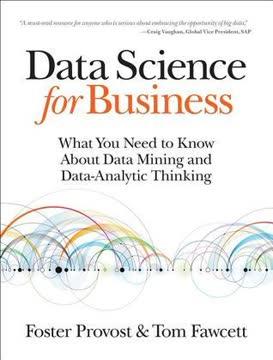
"Data Science for Business" is a strong fit if you want practical ideas around business, technology, science, especially themes like data-driven decision-making bases decisions on evidence rather than intuition and measurably improves business performan; overfitting is the central challenge in data mining: models that perform well on training data may fail on new data. The MinuteRead summary distills these concepts into a focused read, whether you're deciding whether to buy the book or applying its lessons at work.
Foster Provost is an accomplished data scientist and educator. He co-authored "Data Science for Business," which has become a popular textbook for introducing data science concepts to business professionals. Provost's work focuses on making complex data science topics accessible and applicable to real-world business scenarios. He has extensive experience in both academia and industry, contributing to the field through research, teaching, and practical applications. Provost's approach emphasizes …
View all summaries by Foster ProvostContinue Reading
Access the complete 30-minute summary and thousands more nonfiction books in the MinuteRead app.

Continue reading the complete summary in the MinuteRead app.