MinuteRead
30 min
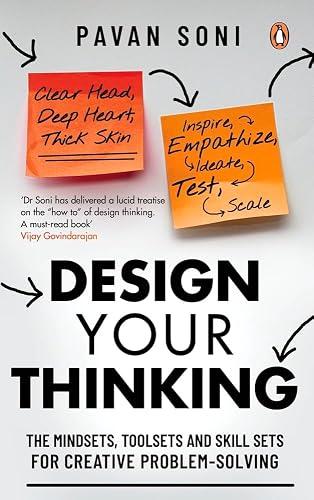
Book summary
by Pavan Soni
Premium summary · Opens in the app · 30 min read
Every organization claims to value innovation. Every leader says they want creative solutions. Yet most people go to work every day and solve problems the same way they always have. They rely on past experience, industry conventions, and incremental improvements. They optimize what already exists rather than imagining what could exist. The result is a world full of products and services that are marginally better than their predecessors but rarely fundamentally better for the people who use them
**Author:** Pavan Soni
**Estimated Reading Time:** 45 minutes
**What You'll Learn:**
- How to apply design thinking as a systematic approach to creative problem-solving - The five-stage framework that takes ideas from inspiration to scale - Why empathy is the foundation of meaningful innovation - How to generate, prototype, and test ideas rapidly - What it takes to build a design thinking culture in your organization - Why embracing failure is essential for breakthrough thinking - How to develop the T-shaped personality that drives innovation
**Who This Book Is For:**
This book is for anyone who wants to solve problems more creatively and systematically. Whether you are an entrepreneur launching a startup, a manager leading a team, a designer looking to formalize your approach, or a professional who wants to bring more innovation to your work, the principles in this book will give you a practical framework for thinking differently. No design background is required. What is required is curiosity, a willingness to challenge assumptions, and the courage to try new approaches.
Every organization claims to value innovation. Every leader says they want creative solutions. Yet most people go to work every day and solve problems the same way they always have. They rely on past experience, industry conventions, and incremental improvements. They optimize what already exists rather than imagining what could exist. The result is a world full of products and services that are marginally better than their predecessors but rarely fundamentally better for the people who use them. This is not because people lack creativity. It is because most organizations lack a systematic way to harness creativity and direct it toward meaningful problems. Creativity without structure produces chaos. Structure without creativity produces stagnation. What is needed is a disciplined approach that combines the best of both worlds: the rigor of a repeatable process with the freedom of open-ended exploration. Design thinking offers exactly this combination. The term design thinking can be misleading. It sounds like something reserved for designers, for people who sketch products or craft user interfaces. But design thinking is not about aesthetics. It is not about making things look beautiful. It is about solving problems in a way that puts human needs at the center of the process. It is a systematic, human-centric approach to problem-solving that anyone can learn and apply, regardless of their role or industry. The origins of design thinking trace back to the realization that the methods designers use to create products could be applied to a much broader range of challenges. Designers do not start with a solution. They start with a deep understanding of the people they are designing for. They observe, they ask questions, they challenge assumptions. They…
Continue reading in the MinuteRead app
Get the complete 30-minute summary of Design Your Thinking
Get the complete summary in the app**Start with empathy.** Understand the people you are designing for before you try to solve their problems. Observe, ask
**Follow the five-stage framework.** Inspire, Empathize and Define, Ideate, Prototype and Test, and Scale. Treat the sta
**Defer judgment during ideation.** Generate many ideas before evaluating them. Quantity breeds quality.
**Prototype early and often.** Make ideas tangible quickly. Test them with real users. Iterate based on feedback.
**Embrace failure as learning.** Fail fast and fail forward. Each failure provides information that guides your next ste
**Balance desirability, feasibility, and viability.** The best solutions satisfy all three criteria.
"Design Your Thinking" is a strong fit if you want practical ideas around self help, design, business, especially themes like **start with empathy.** understand the people you are designing for before you try to solve their problems. observe, ask; **follow the five-stage framework.** inspire, empathize and define, ideate, prototype and test, and scale. treat the sta. The MinuteRead summary distills these concepts into a focused read, whether you're deciding whether to buy the book or applying its lessons at work.
Motivated to help readers with "Design thinking is a systematic, Pavan Soni wrote “Design Your Thinking” to package those ideas for a fast, focused read. In “Design Your Thinking”, Pavan Soni focuses on "Design thinking is a systematic. Through “Design Your Thinking”, Pavan Soni distills the core ideas on self help into lessons readers can absorb in a single short sitting. Readers turn to this work when they want Pavan Soni's perspective on the subject without working through the entire original…
Continue Reading
Access the complete 30-minute summary and thousands more nonfiction books in the MinuteRead app.

Continue reading the complete summary in the MinuteRead app.