MinuteRead
30 min
Book summary
by Bill Eddy
Premium summary · Opens in the app · 30 min read
Most people are reasonable. This is not a sentimental claim. It is a statistical reality. Roughly 80 to 90 percent of the people you meet will be who they say they are. They will do what they say they will do. They will follow the social rules that make cooperation possible. They will disagree with you sometimes, but they will disagree in ways that allow resolution. They will apologize when they are wrong. They will consider your perspective.
**Author:** Bill Eddy
**Estimated Reading Time:** 45 minutes
**What You'll Learn:**
- How to identify the small percentage of people who create disproportionate chaos - The five personality patterns most likely to damage your career, relationships, and wellbeing - A practical method for spotting high-conflict individuals before they entangle you - Strategies to protect yourself when avoidance is impossible - How to respond effectively when someone escalates conflict instead of resolving it
**Who This Book Is For:**
Anyone who has ever wondered why a reasonable conversation turned into a nightmare. Anyone who has been blamed for things they did not do. Anyone who has watched a colleague, family member, or romantic partner transform from charming to destructive. And anyone who wants to make better decisions about who they trust.
Most people are reasonable. This is not a sentimental claim. It is a statistical reality. Roughly 80 to 90 percent of the people you meet will be who they say they are. They will do what they say they will do. They will follow the social rules that make cooperation possible. They will disagree with you sometimes, but they will disagree in ways that allow resolution. They will apologize when they are wrong. They will consider your perspective. This book is not about those people. This book is about the other 10 percent. The people who do not play by the same rules. The people who escalate instead of resolve. The people who blame instead of reflect. The people who leave a trail of damaged relationships, ruined reputations, and exhausted colleagues behind them. Bill Eddy calls these individuals High-Conflict Personalities, or HCPs. He has spent decades working with them as a lawyer, therapist, and mediator. He has seen them in courtrooms, boardrooms, family gatherings, and therapy sessions. And he has noticed something that most people miss: these individuals are not simply difficult. They follow predictable patterns. They share recognizable traits. And once you learn to see those patterns, you can protect yourself from them. The problem is that most of us are not trained to recognize high-conflict personalities until it is too late. We are taught to give people the benefit of the doubt. We are taught to assume good intentions. We are taught that conflict is a two-way street and that we should examine our own contributions to any disagreement. These are useful principles for dealing with reasonable people. They are dangerous principles for dealing with HCPs. A high-conflict personality does not respond to self-reflection. They do not meet you halfway. They do not de-escalate when you remain calm. Instead, they interpret your calmness as weakness. They interpret your willingness to compromise as an admission of guilt. They interpret your…
Continue reading in the MinuteRead app
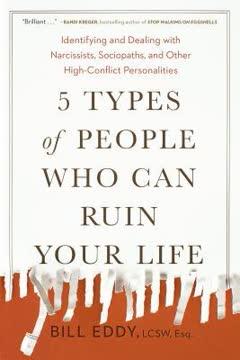
Get the complete 30-minute summary of 5 Types of People Who Can Ruin Your Life
Get the complete summary in the appAbout 10 percent of people are High-Conflict Personalities who escalate conflicts instead of resolving them.
HCPs share four traits: all-or-nothing thinking, unmanaged emotions, extreme behaviors, and preoccupation with blame.
The five types are narcissistic, borderline, antisocial, paranoid, and histrionic.
Use the WEB Method to identify HCPs: evaluate Words, Emotions, and Behavior.
Use the 90 Percent Rule: if 90 percent of people would not do it, it is a red flag.
Avoid HCPs when possible. Proceed slowly, verify claims, and set boundaries early.
"5 Types of People Who Can Ruin Your Life" is a strong fit if you want practical ideas around health & fitness, psychology, self help, especially themes like about 10 percent of people are high-conflict personalities who escalate conflicts instead of resolving them; hcps share four traits: all-or-nothing thinking, unmanaged emotions, extreme behaviors, and preoccupation with blame. The MinuteRead summary distills these concepts into a focused read, whether you're deciding whether to buy the book or applying its lessons at work.
Bill Eddy is a lawyer, therapist, mediator, and President of High Conflict Institute. He developed the High Conflict Personality theory and is an international expert on managing disputes involving high-conflict personalities and personality disorders. Eddy provides training to various professionals and has spoken in multiple countries. He's a Certified Family Law Specialist in California and Senior Family Mediator at the National Conflict Resolution Center in San Diego. Eddy has taught at unive…
View all summaries by Bill EddyContinue Reading
Access the complete 30-minute summary and thousands more nonfiction books in the MinuteRead app.

Continue reading the complete summary in the MinuteRead app.