MinuteRead
30 min
Book summary
Premium summary · Opens in the app · 30 min read
The world of technical analysis is in a peculiar position. On one side stand its practitioners, many of whom have spent decades studying charts, patterns, and indicators. They speak with confidence about head and shoulders formations, Fibonacci retracements, and Elliott Wave counts. They point to successful trades and impressive charts as proof that their methods work. On the other side stand academic researchers, who have spent decades testing these same methods with statistical rigor. Their ve
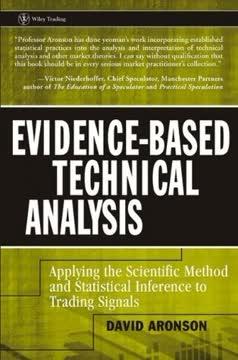
**Author:** David Aronson
**Estimated Reading Time:** 42 minutes
**What You'll Learn:**
- Why most traditional technical analysis fails to deliver on its promises - The cognitive biases that systematically distort trading decisions - How to distinguish between objective and subjective trading methods - The proper way to test whether a trading strategy has real predictive power - How to build a rigorous, evidence-based approach to market analysis
**Who This Book Is For:**
This book is for traders, analysts, and investors who have grown skeptical of conventional technical analysis but still believe markets contain exploitable patterns. It is for anyone who has watched a chart pattern fail, questioned the validity of a popular indicator, or wondered whether their trading success was skill or luck. If you are willing to subject your beliefs to rigorous testing, this book will transform how you think about markets.
The world of technical analysis is in a peculiar position. On one side stand its practitioners, many of whom have spent decades studying charts, patterns, and indicators. They speak with confidence about head and shoulders formations, Fibonacci retracements, and Elliott Wave counts. They point to successful trades and impressive charts as proof that their methods work. On the other side stand academic researchers, who have spent decades testing these same methods with statistical rigor. Their verdict is far less flattering. Most traditional technical analysis methods, when subjected to proper scientific scrutiny, fail to demonstrate reliable predictive power. David Aronson wrote this book because he saw a discipline trapped between these two worlds. Technical analysis, he argues, has not evolved the way other fields have. Medicine once relied on bloodletting and folk remedies before the scientific method transformed it into a practice grounded in evidence. Astronomy once relied on astrology before observation and mathematics revealed the true nature of planetary motion. Technical analysis, however, remains largely where it was a century ago: a collection of subjective interpretations, anecdotal evidence, and untested claims. The problem is not that technical analysis is inherently worthless. The problem is that most of it has never been properly tested. Practitioners assert that certain patterns predict future price movements, but they rarely specify their claims with enough precision to allow objective evaluation. When a pattern fails, they reinterpret it. When a prediction succeeds, they highlight it. This process, repeated over years, creates a false sense of validation. The practitioner genuinely believes their methods work, even when the evidence suggests otherwise. Aronson's central argument is both simple and profound: technical analysis must become an observational science. It must adopt the scientific method, formulate testable hypotheses, and subject its claims to rigorous statistical analysis. He calls this approach evidence-based technical analysis, or EBTA. The goal is…
Continue reading in the MinuteRead app
Get the complete 30-minute summary of Evidence-Based Technical Analysis
Get the complete summary in the appTechnical analysis must become an observational science, using the scientific method to test its claims.
A method is objective only if it can be programmed into a computer that produces unambiguous market positions.
Subjective methods cannot be tested, so claims about their effectiveness are meaningless.
Cognitive biases, including overconfidence, confirmation bias, and hindsight bias, systematically distort trading decisi
A scientific hypothesis must be falsifiable: it must make specific predictions that can be proven wrong.
The data-mining bias inflates backtest results when many rules are tested and the best are selected.
"Evidence-Based Technical Analysis" is a strong fit if you want practical ideas around finance, business, especially themes like technical analysis must become an observational science, using the scientific method to test its claims; a method is objective only if it can be programmed into a computer that produces unambiguous market positions. The MinuteRead summary distills these concepts into a focused read, whether you're deciding whether to buy the book or applying its lessons at work.
David Aronson is a respected figure in the field of technical analysis and quantitative trading. He brings a unique perspective to the subject, combining academic rigor with practical experience. Aronson's background includes a five-year stint as a proprietary trader before transitioning to academia. His work focuses on applying scientific methods and statistical analysis to trading strategies, challenging traditional subjective approaches. Aronson is known for his skepticism towards conventiona…
View all summaries by David AronsonContinue Reading
Access the complete 30-minute summary and thousands more nonfiction books in the MinuteRead app.

Continue reading the complete summary in the MinuteRead app.