MinuteRead
30 min
Book summary
Premium summary · Opens in the app · 30 min read
Every year, sophisticated investors lose billions of dollars to companies that play games with their financial statements. These are not obscure penny stocks or fly-by-night operations. They are household names, companies with Big Four auditors, respected board members, and Wall Street analysts singing their praises. They are companies that appear in your retirement portfolio, your index funds, and your children's college savings accounts.
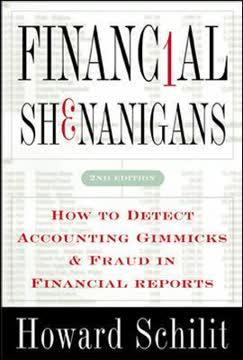
**Author:** Howard M. Schilit
**Estimated Reading Time:** 45 minutes
**What You'll Learn:**
- How companies manipulate revenue, expenses, and cash flow to deceive investors - The seven primary categories of financial shenanigans and how to spot them - Why acquisition accounting creates fertile ground for deception - How to develop a forensic mindset when analyzing financial statements - Practical tools for detecting red flags before they become disasters
**Who This Book Is For:**
Investors who want to protect their capital. Analysts who need to look beyond headline numbers. Board members responsible for oversight. Students of accounting and finance who want to understand how financial statements can be weaponized. Anyone who has ever wondered how companies like Enron, WorldCom, and Valeant managed to fool sophisticated investors for so long.
Every year, sophisticated investors lose billions of dollars to companies that play games with their financial statements. These are not obscure penny stocks or fly-by-night operations. They are household names, companies with Big Four auditors, respected board members, and Wall Street analysts singing their praises. They are companies that appear in your retirement portfolio, your index funds, and your children's college savings accounts. The problem is not that financial statements are useless. The problem is that most investors treat them as objective documents rather than what they actually are: carefully crafted narratives produced by management teams with enormous incentives to make things look better than they really are. Howard Schilit has spent his career uncovering these deceptions. As the founder of the Center for Financial Research and Analysis and later Schilit Forensics, he has identified accounting problems at dozens of companies before they became public scandals. His work has earned him a reputation as one of the world's foremost financial detectives, someone who can read between the lines of a 10-K and spot trouble that everyone else missed. The fourth edition of Financial Shenanigans represents decades of accumulated wisdom about how companies distort their financial picture. It is not a theoretical treatise. It is a field guide to deception, built from real cases, real losses, and real patterns that repeat across industries and decades. Why do companies engage in these behaviors? The answer begins with incentives. Public company executives face relentless pressure to meet quarterly earnings targets. Missing those targets by even a penny can trigger double-digit stock declines. Compensation packages tied to stock prices create powerful motivation to keep the numbers moving in the right direction. When legitimate performance cannot meet expectations, the temptation to adjust the numbers becomes overwhelming. The consequences of falling for these deceptions are severe. Enron shareholders lost approximately $74 billion. WorldCom investors saw roughly $180 billion in market value evaporate. More recently, Valeant Pharmaceuticals collapsed from…
Continue reading in the MinuteRead app
Get the complete 30-minute summary of Financial Shenanigans, Fourth Edition
Get the complete summary in the appFinancial statements are narratives, not objective facts. Always ask who is telling the story and what incentives they h
Revenue is only real when it has been earned and collected. Compare revenue growth to cash collections to spot potential
Expenses can be manipulated just like revenue. Watch for capitalized operating costs, extended depreciation schedules, a
Cash flow can be manipulated. Look beyond the headline number to understand the components of operating cash flow.
Acquisitions create cover for manipulation. Separate organic growth from acquisition-driven growth.
Non-GAAP metrics are controlled by management. Always review the reconciliation to GAAP results.
"Financial Shenanigans, Fourth Edition" is a strong fit if you want practical ideas around finance, business, accounting, especially themes like financial statements are narratives, not objective facts. always ask who is telling the story and what incentives they h; revenue is only real when it has been earned and collected. compare revenue growth to cash collections to spot potential. The MinuteRead summary distills these concepts into a focused read, whether you're deciding whether to buy the book or applying its lessons at work.
Howard Schilit is a renowned expert in forensic accounting and financial analysis. He founded the Center for Financial Research and Analysis and currently serves as CEO of Schilit Forensics. Schilit's expertise lies in detecting accounting gimmicks and fraudulent financial reporting. He has authored multiple editions of Financial Shenanigans , which has become a standard text in the field. Schilit's work has been widely recognized, with publications like Barron's referring to him as a "financial…
View all summaries by Howard M. SchilitContinue Reading
Access the complete 30-minute summary and thousands more nonfiction books in the MinuteRead app.

Continue reading the complete summary in the MinuteRead app.